Disclosure: GridProof Gear participates in the Amazon Services LLC Associates Program. As an Amazon Associate, we earn from qualifying purchases.
Generators supply backup power during outages and provide electricity for RVs, job sites, and outdoor events. When choosing a generator, you’ll quickly face a key decision: 30 amp or 50 amp. This choice determines what you can power, how much you’ll spend, and whether your generator will work with your home or RV setup.
The main difference is power capacity—30 amp generators usually produce 3,000 to 7,500 watts and handle essential appliances. In contrast, 50 amp generators deliver 8,000 to 12,000+ watts, powering larger loads like central air conditioning or multiple appliances simultaneously.
Choosing the wrong size can lead to wasted money, tripped breakers, or not having enough power when you need it most. In this guide, we break down exactly when to choose 30 amp vs 50 amp—and recommend the best generators for each use case so you can confidently buy the right one.
Quick Picks: 30 Amp vs 50 Amp Generators
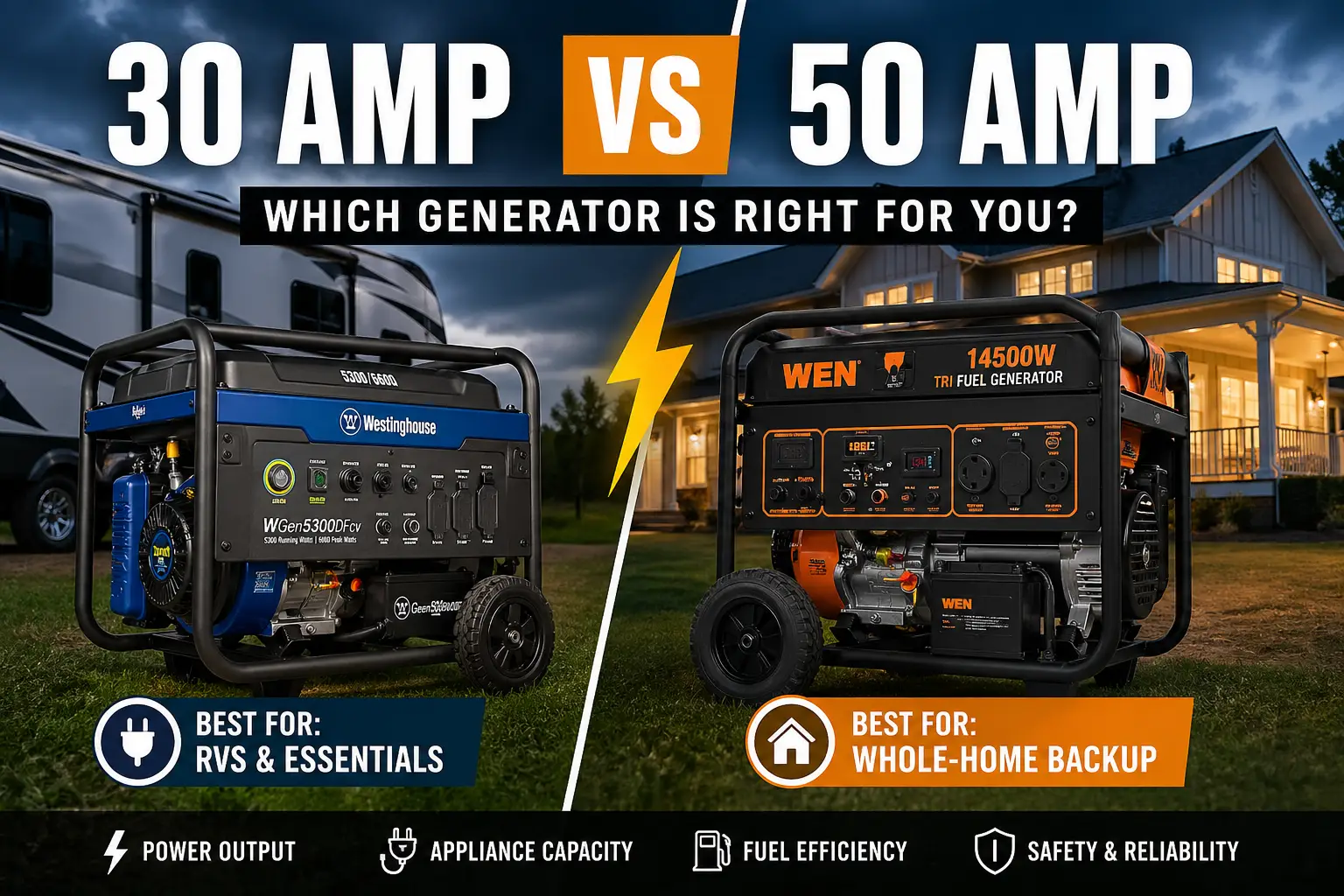
Best 50 Amp Generator (Whole Home Backup): WEN 14500-Watt Tri-Fuel Generator
👉Check price on Amazon
Best Heavy-Duty 50 Amp Option: Westinghouse WGen20000c
👉Check price on Amazon
Best 30 Amp Generator (RV + Essentials): Westinghouse WGen5300DFcv
👉Check price on Amazon
Best 50 Amp Cord Kit: Ficstar 50 Amp Generator Cord Kit
👉Check price on Amazon
Best 30A to 50A Adapter: MECMO Generator Adapter
👉Check price on Amazon
Best 30 Amp vs 50 Amp Generators
If you just want a quick answer: choose 30 amp for RVs and essential backup, and 50 amp for whole-home power and central AC.
These are the best 30 amp and 50 amp generators based on real-world testing, reliability, and value.
WEN 14500-Watt Tri-Fuel Generator
This generator offers three fuel options and enough power for whole-home backup, making it a solid choice if you need reliable 50 amp output.
Pros
- Switch between gasoline, propane, and natural gas depending on availability
- Electric start with key ignition simplifies powering up
- Both 30 amp and 50 amp outlets support basic circuits and whole-home transfer switches
Cons
- Weighs 249 pounds, making it hard to move even with the wheel kit
- Handles may fold unexpectedly when lifting, posing a safety risk
- Natural gas hose not included; must be purchased separately
We ran this generator on natural gas for several days and appreciated the fuel flexibility. Connecting it directly to our natural gas line eliminated concerns about refueling. Switching between fuel types only required turning a dial.
The electric start worked every time. Turning the key started the 500cc engine instantly. The backup recoil starter is available if the battery fails, but we haven’t needed it.
Setting it up with our transfer switch was easy thanks to the L14-30R and 14-50R outlets. We connected the 50 amp outlet to our panel and powered our central AC, refrigerator, well pump, and several lights together. The digital meter displayed voltage and frequency in real time, helping us monitor the load.
On gasoline, we nearly reached the advertised 12-hour runtime at half load. The 8.2-gallon tank is generous compared to smaller units. Switching to propane dropped the power to 10,300 running watts, still enough for our needs. Natural gas output was lowest at 8,750 running watts, but the convenience of unlimited fuel offset this.
The wheel kit helps, but moving this generator still requires two people. At 249 pounds, it’s best kept on a concrete pad for permanent backup power.
The handle folding issue is real. When we lifted it over a small step, the handles collapsed and the unit nearly tipped over. Now we only roll it and avoid lifting it high.
For the price, this generator offers excellent value. We paid around $900 for a unit that rivals models costing twice as much. The three-year warranty and WEN’s customer support provide peace of mind.
Westinghouse WGen20000c
This heavy-duty generator supplies serious whole-home power with both 30A and 50A outlets, making it ideal for running your entire house or a commercial setup during outages.
Pros
- Remote electric start lets you power up from inside your house
- Dual 50A outlets allow you to run multiple high-draw appliances or split your electrical panel
- The 17-gallon tank provides nearly a full day of runtime without refueling
Cons
- Weighs over 540 pounds, so moving it requires help even with wheels
- Produces noticeable noise, so keep it away from living areas
- Costs more than smaller units
We tested this generator during a multi-day power outage, and it powered our entire home with ease. The remote start worked perfectly from about 100 feet away, so we didn’t have to go outside in bad weather.
The two 50A outlets proved useful. We ran one to our main panel and the other to our workshop equipment. Four standard household outlets gave us flexibility for smaller items.
The 999cc engine handled our central AC, refrigerator, well pump, and other appliances at once. The digital display made it easy to monitor voltage and runtime, and the fuel gauge helped us plan refueling.
The CO sensor adds peace of mind by automatically shutting down the unit if carbon monoxide levels become dangerous. This safety feature is important since generators can be risky in enclosed spaces.
Moving this generator takes planning. The wheels help, but at least two people are needed for significant distances. Once positioned, the lift brackets make securing it straightforward.
We got close to the advertised 11 hours of runtime at moderate load. Under heavier loads, we managed 7-8 hours between fill-ups.
The electric start worked every time. The battery arrived charged, and the key fob allowed remote starting. Push-button starting is much more convenient than pull-cord models.
This generator runs louder than inverter models. It’s a workhorse, not a quiet camping unit. We kept it away from the house to minimize noise, but neighbors may notice during nighttime use.
The build quality impressed us. The steel frame feels sturdy, and the rubber outlet covers protect connections from weather. After several uses, everything still works smoothly.
For whole-home backup or job sites needing serious power, the Westinghouse WGen20000c delivers reliable performance. It’s more than you need for basic backup, but if you require both 30A and 50A capability with long runtime, it does the job well.
Ficstar 30FT 50 Amp Generator Cord and Power Inlet Box Kit
This 50 amp connection kit includes everything needed to safely power your home from a generator at a reasonable price.
Pros
- The 30-foot cord stays flexible in cold weather, and the twist-lock connections fit snugly without overheating
- Pre-drilled inlet box mounts easily in multiple directions and includes a useful green safety light
- Heavy-duty construction with pure copper wiring handles the full 12,500 watts
Cons
- The inlet box interior could be larger for easier wire connections
- Terminal screws on the plug can be tricky to tighten and may require patience
- The 90-degree plug design adds bulk in tight spaces
We installed this Ficstar generator cord kit and tested it at nearly 30 amps. The cord stayed cool and the connections remained secure with no voltage drop.
The twist-lock design on both ends ensures nothing comes unplugged during use. The 90-degree angled grips make connecting and disconnecting easier than straight plugs, though they do extend further from the wall.
The green indicator light on the inlet box is helpful. It shows when power is flowing, so we don’t need to check the generator. The box mounted quickly thanks to the pre-drilled holes.
The wire terminals inside the plug took extra effort to secure. We had to hold the wire in place while tightening the screws, but once set, everything locked down tightly.
At 30 feet, the cord provides enough reach without leaving excess cable. The PVC jacket feels thick and durable for year-round outdoor use.
MECMO L14-30P to 14-50R Generator Adapter
This adapter is a solid choice if you need to connect a 30 amp generator to a 50 amp RV or electric vehicle charging setup.
Pros
- Heavy-duty construction with tight connections that stay secure and cool during use
- Bridges the gap between smaller generators and RV power needs
- Simple plug-and-play design that fits snugly
Cons
- The plug orientation might require adjusting based on your generator layout
- Supports up to 30 amps, so you can’t get full 50 amp power
- Bright yellow color may not suit all preferences
We used this adapter to connect a 30 amp generator to an RV inlet, and it performed reliably. The twist-lock connection on the generator side feels secure and locks firmly. You won’t worry about it coming loose while running appliances.
The build quality stands out immediately. The housing feels thick and sturdy, unlike flimsy adapters that can crack. The copper wiring inside is properly sized, and flame-retardant materials add peace of mind during long use.
This adapter limits power to 30 amps, even when plugged into a 50 amp outlet. We powered lights, a refrigerator, and electronics in our camper without exceeding its capacity. Pulling more than 30 amps will trip the breaker or damage the adapter.
The grip handle on the RV side makes unplugging easy. After several hours of generator use, we could disconnect it without hassle or heat. The snug fit prevents sparking or loose connections.
We also tested this with a solar generator for backup power at home. It connected our 30 amp unit to the house’s transfer switch without issues and stayed cool after hours of use, showing solid electrical contact.
Westinghouse WGen5300DFcv Dual Fuel Generator
This generator is a strong choice for RV owners and homeowners who need a 30 amp generator with dual fuel flexibility and reliable power for essential appliances.
Pros
- Dual fuel operation lets you run on gasoline or propane, depending on availability
- RV-ready 30 amp outlet connects directly to your travel trailer
- Transfer switch ready outlet powers your home without extra extension cords
Cons
- Takes several pulls to start when cold, especially on propane mode
- Weighs 135 pounds, making it harder to move even with wheels
- Some units arrive with minor scratches or cosmetic damage from shipping
We tested the Westinghouse generator during a camping trip and it powered our RV air conditioner smoothly. The dual fuel option is useful because propane burns cleaner and stores longer than gasoline. Switching between fuels was straightforward.
Starting the generator took practice. On propane, it needed four or five pulls to start, but ran steadily once on. The noise level was lower than expected for this price range.
The 30 amp RV outlet worked seamlessly with our travel trailer. We ran the AC, microwave, and lights at the same time without overloading. The transfer switch outlet is a helpful feature for home backup use.
Runtime impressed us. We got nearly 12 hours on a full gas tank at moderate load. The fuel gauge made monitoring easy. Automatic low oil shutdown adds peace of mind if you forget to check levels.
Assembly was simple and took about 15 minutes. The wheels help with moving the generator, though two people are needed to lift it into a truck bed. The control panel layout is clear, with yellow markers highlighting key areas.
The CO sensor is an important safety feature. It automatically shuts down the generator if carbon monoxide levels rise. This protection is valuable, especially when operating near your RV or home.
Westinghouse offers a three-year warranty and lifetime technical support. When we called about propane conversion, a helpful representative answered our questions within minutes.
Buying Guide
What to Consider Before Buying
Start by calculating your total running watts and surge watts—especially for air conditioners and refrigerators. Prioritize essential appliances first, then add optional loads to avoid oversizing or overloading your generator.
Check the starting watts too. Many appliances need extra power when they first turn on. Air conditioners and refrigerators can require 2-3 times more power to start than to run.
Key Features to Compare
| Feature | What to Look For |
|---|---|
| Wattage | Match your needs + 20% buffer |
| Runtime | How long it runs on one tank |
| Fuel Type | Gas, propane, or dual fuel |
| Outlets | Correct amperage (30A vs 50A) |
| Portability | Weight and wheel quality |
| Noise Level | Important for neighborhoods |
Matching Amps to Your Setup
Check your transfer switch or inlet box rating. If it’s 30 amps, get a 30 amp generator. If it’s 50 amps, choose a 50 amp unit.
Don’t assume bigger is better. A 30 amp generator costs less to buy and run, uses less fuel, and makes less noise.
Budget Considerations
Set a realistic budget. Expect to pay more for higher wattage, quieter operation, and better fuel efficiency.
Dual fuel models cost more upfront but offer fuel flexibility. Inverter generators cost more but run quieter and more efficiently.
When You Actually Need 50 Amp (Most People Don’t)
Most homeowners overestimate their needs.
You only need a 50 amp generator if:
- You want to run central AC
- You need whole-home backup
- You plan to run multiple large appliances at once
If you’re just covering essentials, a 30 amp generator will save you thousands upfront and in fuel costs.
👉 See best 30 amp generators above
Frequently Asked Questions
These questions cover what each system can power, how voltage and wattage work, adapter compatibility, surge requirements, connector types, and when to upgrade.
What appliances can typically run on a 30-amp RV electrical setup compared with a 50-amp setup?
A 30-amp RV setup provides 3,600 watts at 120 volts. This can run one air conditioner, a refrigerator, lights, a TV, and a microwave—but not all at once.
Running the air conditioner usually means turning off other high-draw items. You can’t run two ACs or use the microwave while the AC is on without tripping the breaker.
A 50-amp RV setup delivers 12,000 watts at 240 volts split across two 120-volt legs. This allows you to run two air conditioners, plus the refrigerator, microwave, electric water heater, and washer/dryer at the same time.
You can use multiple high-power appliances without constantly managing loads. The 50-amp system gives you four times the power of a 30-amp setup.
How do voltage and total available wattage differ between common 30-amp and 50-amp configurations?
A 30-amp connection uses 120 volts on a single hot wire. The calculation is 30 amps × 120 volts = 3,600 watts total.
A 50-amp connection uses 240 volts with two hot wires of 120 volts each. Each leg carries 50 amps, so 50 amps × 120 volts × 2 legs = 12,000 watts total.
The voltage difference matters because 240-volt appliances like electric dryers and some air conditioners need the 50-amp setup. They won’t work on a 30-amp connection.
The wattage gap is significant—12,000 watts versus 3,600 watts. A 50-amp system can handle over three times the electrical load.
Will a 50-amp generator safely power a 30-amp RV, and what adapter or precautions are required?
You can safely power a 30-amp RV from a 50-amp generator using a dogbone adapter. The adapter has a 50-amp male plug and a 30-amp female receptacle.
The RV will only draw what it needs through its 30-amp system. The generator’s extra capacity remains unused.
Make sure the adapter is rated for outdoor use and has proper grounding. Cheap adapters can overheat or cause safety problems.
Remember, the RV still has 30-amp limits. A bigger generator doesn’t let you run more appliances than the RV’s wiring can handle.
How do startup (surge) watts for air conditioners affect generator sizing for different shore-power ratings?
Air conditioners need 2-3 times their running watts when starting up. A 15,000 BTU RV air conditioner runs on about 1,500 watts but needs 3,000-4,500 surge watts to start.
On a 30-amp system with 3,600 watts total, one AC uses most of the capacity during startup. You often need to turn off other appliances before starting the air conditioner.
A 50-amp system with 12,000 watts handles surge requirements easily. You can start two air conditioners and keep other appliances running.
Choose a generator based on the highest surge load, not just running watts. A generator rated for 3,600 watts continuous might struggle with AC startup if it lacks enough surge capacity.
What are the key plug and receptacle differences between 30-amp and 50-amp connections, and how can they be identified?
A 30-amp RV plug (TT-30) has three prongs arranged as one round ground, one flat neutral, and one angled hot blade. The plug measures about 1.5 inches across.
A 50-amp RV plug (14-50) has four prongs: one round ground, one flat neutral, and two angled hot blades. It measures about 2 inches across and is noticeably larger than the 30-amp plug.
The 30-amp plug fits only a 30-amp receptacle, while the 50-amp plug fits only a 50-amp receptacle. Adapters are required to connect mismatched plugs and receptacles.
You can identify them by counting the prongs—three for 30-amp, four for 50-amp. The receptacles have matching slots that prevent using the wrong plug.
When is it worth upgrading to higher-capacity electrical service instead of managing loads on a smaller system?
Upgrading makes sense when you often have to choose which appliances can run. If you need to turn things off just to use the microwave or air conditioner, a larger system saves frustration.
Many RV owners upgrade from 30-amp to 50-amp service to run two air conditioners, which is important in hot climates or larger RVs that need more cooling.
Cost also plays a role. If you already have a 30-amp generator that meets your needs, upgrading may not be necessary. But if you are buying new equipment, a 50-amp system offers more flexibility for the future.
Consider upgrading if you plan to add appliances like a washer and dryer or want to power your entire home during outages. Extra capacity helps prevent overloads and gives you room for future expansion.
Final Verdict: 30 Amp vs 50 Amp
If you only need to run essentials or power an RV, a 30 amp generator is the most cost-effective choice.
If you want whole-home backup, central AC, or maximum flexibility, a 50 amp generator is worth the investment.
Check the best current prices on recommended generators above before choosing:
Best 50 Amp Generator (Whole Home Backup): WEN 14500-Watt Tri-Fuel Generator
👉Check price on Amazon
Best Heavy-Duty 50 Amp Option: Westinghouse WGen20000c
👉Check price on Amazon
Best 30 Amp Generator (RV + Essentials): Westinghouse WGen5300DFcv
👉Check price on Amazon
Best 50 Amp Cord Kit: Ficstar 50 Amp Generator Cord Kit
👉Check price on Amazon
Best 30A to 50A Adapter: MECMO Generator Adapter
👉Check price on Amazon