Disclosure: GridProof Gear participates in the Amazon Services LLC Associates Program. As an Amazon Associate, we earn from qualifying purchases.
When a power outage hits, homeowners with portable generators need a safe, code-compliant, and reliable way to connect backup power to their home. Running extension cords throughout your house is inefficient, unsafe, and not a long-term solution. The two main solutions for safely connecting a portable generator to your electrical panel are generator interlock kits and transfer switches—and choosing the wrong one can cost you time, money, and safety
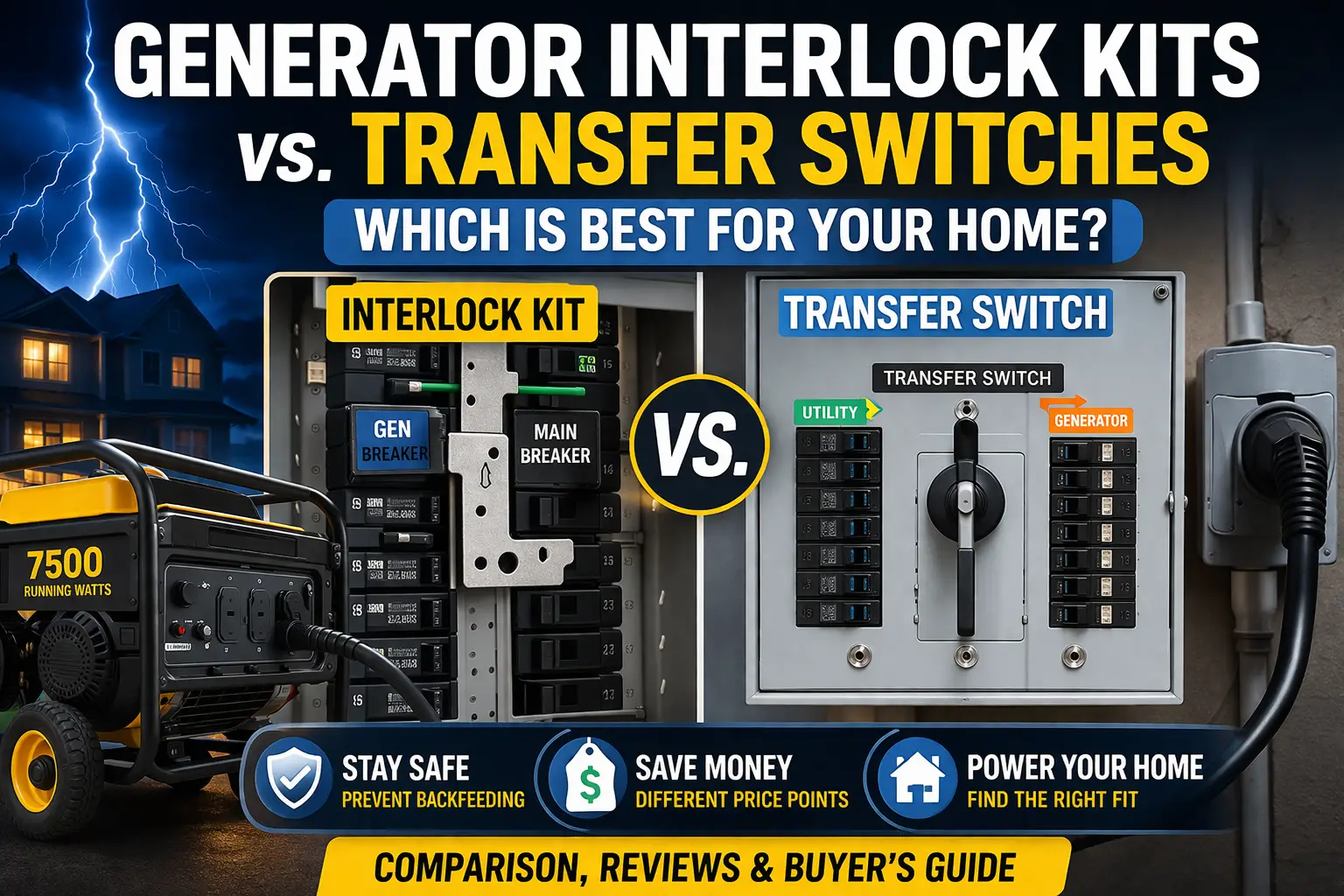
Generator interlock kits and transfer switches both prevent backfeeding, which sends electricity backward into utility lines and creates a hazard for utility workers. An interlock kit is a mechanical device that mounts directly to your electrical panel and blocks both the main breaker and generator breaker from being on at the same time. A transfer switch is a separate device that physically switches your circuits between utility power and generator power.
Your budget, the number of circuits you need to power, and your electrical panel compatibility are the most important factors when choosing between these systems. Interlock kits usually cost less and let you power your entire panel, while transfer switches give you dedicated circuits but require more installation work. We researched and compared the best generator interlock kits and transfer switches for 2026.
👉 Check the best generator transfer switch deals on Amazon before the next outage
Best Generator Interlock Kits and Transfer Switches (2026 Buyer’s Guide)
We tested and compared the top generator interlock kits and transfer switches to help you safely connect backup power to your home. Below are the five best options based on safety features, ease of installation, and overall value.
Reliance Controls 30 Amp Transfer Switch Kit
This transfer switch kit provides a complete, beginner-friendly solution for safely powering essential circuits. You can safely power up to six essential circuits during an outage with straightforward manual switching between utility and generator power.
The kit works with most standard generators that have 30-amp output capacity. It includes a power inlet box, transfer switch, and all necessary hardware for installation.
Installation requires basic electrical knowledge, but most homeowners hire an electrician for safety and code compliance
Pros:
- Complete kit with all components included
- Clear circuit labeling for easy operation
- Pre-wired connections save installation time
Cons:
- Limited to six circuits
- Requires outdoor mounting space for inlet box
- 30-amp capacity may not support larger appliances simultaneously
GenInterlock Generator Interlock Kit
This interlock kit mounts directly inside your electrical panel, giving you full control over your home’s circuits during an outage. Its mechanical design blocks both power sources from being connected, protecting utility workers and your equipment.
The kit works with specific Square D and Siemens panel models, so verify compatibility before purchasing. It supports your panel’s full amperage rating, allowing you to run any circuit as long as your generator can handle the load.
Installation requires working inside your electrical panel, so you should hire a qualified electrician. Your local building department will likely require a permit and inspection.
Pros:
- Uses all existing circuits without rewiring
- Lower cost than transfer switch systems
- Compact design fits inside panel
Cons:
- Only compatible with specific panel brands and models
- Requires careful manual operation during power transfers
- Installation must follow strict electrical codes
Reliance Controls 50 Amp Transfer Switch
This heavy-duty transfer switch handles up to 50 amps, making it ideal for larger homes and higher power demands. You get more circuits and higher capacity than the 30-amp version, letting you run more appliances at once.
The switch works with generators rated for 12,500 watts or less. It features a clear status indicator showing which power source is active.
You mount this switch near your electrical panel and wire it to the circuits you want to power during outages. A professional electrician can ensure the system meets local electrical codes and works safely.
Pros:
- Ten circuit capacity for whole-home coverage
- 50-amp rating supports high-wattage appliances
- Durable outdoor-rated enclosure
Cons:
- Higher cost than 30-amp models
- Requires larger generator to use full capacity
- Takes up more wall space than interlock kits
Square D Generator Interlock Kit
This interlock device installs in Square D Homeline load centers and provides a reliable, code-compliant generator connection. The sliding mechanism physically blocks you from turning on both the main breaker and generator breaker at the same time.
The kit only fits specific Square D panel models, so match the model number exactly. It allows you to use your panel’s full amperage rating and all installed circuits.
An electrician should install this kit to ensure it meets National Electrical Code requirements. You will also need to add a generator breaker to your panel if one is not already installed.
Pros:
- Works with existing panel circuits
- Simple sliding mechanism is easy to operate
- Most affordable backup power option
Cons:
- Limited to Square D Homeline panels only
- Generator breaker sold separately
- Manual operation requires you to flip breakers during transfers
Connecticut Electric Generator Transfer Switch
This transfer switch system provides simple, user-friendly push-button operation, making it ideal for beginners. The 30-amp switch handles up to 7,500 watts across six circuits.
The switch works with most portable generators that have standard 30-amp outlets. It includes a weatherproof power inlet box for outdoor generator connections.
You need to choose and wire the six circuits you want available during outages. Professional installation ensures proper grounding and code compliance for safe operation.
Pros:
- Easy push-button switching between power sources
- Weatherproof components for outdoor durability
- Compact design fits in tight spaces
Cons:
- Only six circuits available during outages
- 30-amp limit restricts simultaneous appliance use
- Requires circuit prioritization during installation
VEVOR Manual Transfer Switch
This transfer switch features solid construction and convenient pre-wiring at a budget-friendly price, however, the lack of UL certification is a serious drawback and may not meet local electrical code requirements.
Pros
- Pre-wired setup with labeled connections speeds up installation
- Weatherproof NEMA 3R enclosure protects against rain, snow, and dust
- Includes power inlet box with CS6375 plug and built-in watt meter
Cons
- No UL certification, which raises safety concerns for some users
- Some users reported circuit failures after a few hours of use
- Kit does not include extra conduit connections
Compatibility and Capacity
The VEVOR supports up to 50 amps and works with generators up to 12,500 watts. You can manage 10 circuits using its double-throw switch. The CS6375 plug on the power inlet box fits most portable generators in this range.
Build Quality and Features
The sturdy metal frame feels durable. All wires come labeled from the factory, saving time during setup. The weatherproof enclosure shields internal components from outdoor conditions.
The built-in watt meter lets you monitor generator output. The mechanical design works without batteries or extra power.
Installation and Use
Setup is quicker than with non-prewired options because internal connections are complete. You still need to connect the unit to your main panel and run the inlet box wire. Extra conduit fittings may be necessary, as they’re not included.
The double-throw switch ensures you never connect grid and generator power at the same time. Flip the switches to transfer selected circuits from utility to generator power.
Reliability Concerns
While many users report good results, the lack of certification and reported failures make this a higher-risk option compared to UL-listed alternatives. The lack of UL certification means this unit hasn’t undergone independent safety testing, which is important in areas where local codes require certified equipment.
Weighing 21 pounds, one person can install it. The compact size (14.65 x 9.76 x 4.72 inches) fits easily near your electrical panel.
Nature’s Generator Transfer Switch
This transfer switch offers reliable performance and flexibility for powering multiple circuits during an outage.
Pros
- Handles up to 12 circuits with flexible voltage configuration
- Steel construction feels sturdy; illuminated rocker switch makes positions easy to see
- Wire length suits most breaker positions
Cons
- Wire labels fall off easily, causing confusion during installation
- Instructions cover many panel types and can be hard to follow
- Some setups may require extra wire length
The build quality stands out immediately. The steel housing feels solid, and the rocker switches provide a clear, satisfying click when switching between utility and generator power.
Installation requires some electrical knowledge. The wires are numbered, but the identification tags may detach, so double-check each wire before making connections. Most users find the included wire length adequate for reaching their breakers.
The 50-amp capacity supports most home backup needs. You can set it up for six 240V circuits or twelve 120V circuits. The included power inlet box offers flexibility for different generator types.
The illuminated switch is especially useful during outages, letting you see the switch position without a flashlight. The rocker mechanism operates smoothly and feels durable.
Installation goes more smoothly if you watch tutorial videos. The manual covers many scenarios, making it difficult to find instructions specific to your setup. Electricians will have no trouble, but DIY installers should allow extra time to review the documentation.
Generac 200-Amp Automatic Transfer Switch
This transfer switch provides fully automatic backup power with zero manual effort required
Pros
- Automatically switches between utility and generator power
- Brownout protection keeps your system stable during voltage drops
- Quick-mount design simplifies installation
Cons
- Works only with Generac generators
- Weighs 30 pounds, so mounting alone can be difficult
- Higher upfront cost than manual kits
This Generac automatic transfer switch activates within seconds of an outage, eliminating the need for manual intervention.
The mounting system made installation faster than expected. The enclosure attaches to standard surfaces without extra brackets or complicated hardware. Everything lined up properly on my exterior wall.
Brownout protection proved useful during a storm with fluctuating voltage. The system handled dips without shutting down or damaging the generator. The hardened control module is solid and weatherproof.
The aluminum housing stands up well to outdoor conditions. Rain and temperature changes haven’t affected performance. Screw terminals made wiring straightforward.
This switch requires a Generac generator and won’t work with other brands. The weight means you should have help when mounting. Once installed, it delivers reliable, automatic backup power whenever you need it.
MUJURUR 100A Manual Transfer Switch
This transfer switch is a solid choice for handling heavy electrical loads and offers durability at a reasonable price.
Pros
- Simple mechanical design reduces risk of failure from moisture or electronics
- 24,000-watt capacity runs your entire home, including high-demand appliances like dryers and stoves
- Galvanized steel case is durable and provides ample wiring space
Cons
- Larger size can make placement challenging in tight spaces
- No dedicated grounding lug, which some electricians prefer
- Terminal connections may feel cramped with very thick wire
I set this up for a solar-hybrid system and found it worked well. The lever moves smoothly, and you can always tell which power source is active. The ON-NONE-ON operation prevents accidental backfeeding into the grid.
The aluminum connections are easy to wire if you have basic electrical skills. However, hiring a professional electrician is wise unless you’re comfortable working inside an electrical panel. The NEMA 3R rating allows safe outdoor installation.
The lock hole at the bottom prevents accidental switching. I tested it with both a gas generator and solar input, and the switch performed as expected. The 100-amp rating is suitable for most homes running 50-60 amps.
The 10-year warranty demonstrates the manufacturer’s confidence in the product. At this price, it offers excellent value compared to more expensive alternatives.
Detailed Comparison: Interlock Kits vs Transfer Switches
Reliance Controls 30 Amp Transfer Switch Kit
This kit is ideal for smaller homes or when you only need to power essential circuits. It comes as a complete package with everything needed to get started.
The 30-amp capacity handles most critical loads like your refrigerator, furnace, and some lights. You’ll need to choose which circuits are most important since you can’t run everything at once. Installation takes a few hours for those comfortable with electrical work.
Pros
- Complete kit includes transfer switch, power inlet box, and installation hardware
- Pre-wired circuits make setup quicker than starting from scratch
- Works with most portable generators rated for 7,500 watts or less
Cons
- Limited to six circuits, so you’ll need to prioritize
- Not suitable for whole-home backup
- Plastic enclosure is less durable than metal options
GenInterlock Generator Interlock Kit
Interlock kits offer a cost-effective way to connect a generator to your entire electrical panel. This model fits many common panel brands and costs much less than a transfer switch.
Install the metal plate inside your breaker box next to a dedicated generator breaker. The mechanical interlock ensures that the main breaker and generator breaker cannot be on at the same time. This setup lets you power any circuit in your home by flipping individual breakers.
Pros
- Much cheaper than transfer switches
- Lets you choose which circuits to power
- Takes up minimal space inside your existing panel
Cons
- You must verify compatibility with your panel model before ordering
- Requires an available breaker slot, which some full panels lack
- Installation can be complex and needs a licensed electrician
Reliance Controls 50 Amp Transfer Switch
This mid-range transfer switch offers more power capacity than a 30-amp model and features a ten-circuit design suitable for medium-sized homes.
Your generator should produce at least 12,500 watts to use this switch fully. The front wattmeter helps you monitor power usage to avoid overloading your generator. Each circuit connects to clearly labeled terminals.
Pros
- Ten circuits cover most essential home systems
- Built-in wattmeter shows real-time power use
- Sturdy metal construction for durability
Cons
- Heavier and larger than 30-amp versions, so it needs more wall space
- Pre-wired layout may not match your exact needs
- More expensive than interlock kits with less flexibility
Square D Generator Interlock Kit
Square D panels are common in many homes, and this interlock kit fits their QO and Homeline series. The quality meets the standards of a major electrical manufacturer.
This kit includes the interlock plate and all necessary mounting hardware. You will need to buy a compatible generator breaker separately. The stainless steel construction resists rust and corrosion.
Pros
- Precision fit for Square D panels eliminates compatibility concerns
- Stainless steel construction lasts longer than painted alternatives
- Simple mechanical design with no parts to wear out
Cons
- Only works with specific Square D panel models
- Generator breaker sold separately increases the total cost
- Most local codes require professional installation
Connecticut Electric Generator Transfer Switch
Connecticut Electric offers a budget-friendly transfer switch for basic backup power needs. The six-circuit capacity covers your most important loads without unnecessary complexity.
This 30-amp switch comes pre-wired and ready to install.
Buying Guide
When choosing between an interlock kit and a transfer switch, consider your budget, electrical needs, and installation preferences.
Key Features to Consider
Always match the transfer switch or interlock kit to your generator’s amperage and wattage output. Most homes require 30 to 50 amps for essential circuits. Match this to your generator’s output.
Verify compatibility with your exact electrical panel model—this is critical for interlock kits. Not all products fit every panel type. Review manufacturer specifications before buying.
Consider installation complexity. Some options require a professional electrician, while others suit experienced DIYers.
Important Comparison Factors
| Feature | What to Look For |
|---|---|
| Amperage Rating | Match your home’s power needs (30A, 50A, etc.) |
| Panel Compatibility | Verify fit with your specific electrical panel model |
| Code Compliance | Ensure meets local building and electrical codes |
| Installation Type | Determine if professional installation is required |
| Number of Circuits | Count how many circuits you need to power |
Safety and Legal Requirements
Your purchase must meet local electrical codes. Check with your local building department about permit requirements.
Always choose UL-listed products—this is essential for passing inspections, meeting code, and protecting your home insurance coverage. UL listing ensures the device has been tested for safe operation.
Decide whether you want to power your entire home or just essential circuits. This choice affects the product type and amperage rating you need.
Which Should You Choose?
- Choose an interlock kit if you want the cheapest way to power your whole panel
- Choose a transfer switch if you want simplicity and pre-selected circuits
- Choose an automatic transfer switch if you want hands-free backup power
Frequently Asked Questions
Generator interlock kits and transfer switches differ in design, installation complexity, and cost. Both systems prevent back-feeding electricity into power lines, but they operate differently and require different investments.
Generator Interlock Kit vs Transfer Switch: What’s the Difference?
A generator interlock kit uses a sliding metal plate to prevent your main breaker and generator breaker from being on at the same time. You manually flip individual circuit breakers to choose which circuits receive generator power.
A transfer switch creates a separate system that switches your home between utility and generator power. Manual transfer switches require you to flip a switch or turn a dial, while automatic transfer switches detect power outages and switch sources automatically.
The interlock kit keeps all your existing circuit breakers in place. A transfer switch usually requires a sub-panel with its own breakers for the circuits you want to power during an outage.
Is an interlock kit as safe as a transfer switch?
Both systems prevent back-feeding when installed correctly. Back-feeding occurs when electricity from your generator flows back into utility lines, which can endanger utility workers restoring power.
An interlock kit uses a mechanical plate to physically block both breakers from being on simultaneously. You can easily verify the safety mechanism each time you use it.
Transfer switches isolate your home from the utility grid using internal switching mechanisms. Quality switches have proven reliable over decades of use.
How does the installation process compare for a generator interlock kit versus a transfer switch?
Installing an interlock kit takes less time because you mount it directly to your existing electrical panel. You add a new breaker for the generator and attach the interlock plate. Most installations take 2-4 hours for a licensed electrician.
A manual transfer switch requires mounting a separate box near your main panel. The electrician runs wires from specific circuits in your main panel to the new transfer switch panel. This process typically takes 4-8 hours.
An automatic transfer switch adds complexity. It needs control wiring to monitor utility power and activate the switching mechanism. Some models can even start your generator automatically, which requires extra wiring between the switch and generator.
What are the cost implications of selecting a generator interlock kit over a transfer switch?
Generator interlock kits cost between $50 and $300 for the parts. You also need to budget for the generator breaker and inlet box. Total material costs usually stay under $500.
Manual transfer switches range from $300 to $800 for a basic 6-10 circuit model. Larger switches cost more. Installation costs are higher due to additional labor.
Automatic transfer switches start around $500 for smaller units and can exceed $2,000 for whole-house systems. Professional installation for automatic switches often costs $1,500 to $3,000 because of the complex wiring and setup.
Can a generator interlock kit adequately replace the need for a standard transfer switch?
An interlock kit suits homeowners who don’t mind managing circuits manually during a power outage. You walk to your electrical panel and flip breakers on or off based on your generator’s capacity and your needs.
Transfer switches offer more convenience by pre-selecting your critical circuits. You flip one switch and your chosen circuits receive power immediately, which is helpful during emergencies when you want fast, simple operation.
For homes needing automatic backup power, an interlock kit cannot replace an automatic transfer switch. Only automatic transfer switches provide power without requiring someone to be home and take action.
Is there a maximum amperage for which generator interlock kits are still considered effective?
Interlock kits work effectively up to 200 amps, covering most residential electrical panels. You can find interlock kits for 100-amp, 150-amp, and 200-amp panels.
The main limitation is your panel’s design and available space. Some panels have layouts that make interlock installation difficult or impossible.
Generators larger than 200 amps typically serve commercial buildings or very large homes. These setups usually require transfer switches for code compliance and advanced load management.