Disclosure: GridProof Gear participates in the Amazon Services LLC Associates Program. As an Amazon Associate, we earn from qualifying purchases.
When a storm knocks out power, the effects go beyond losing lights. Your refrigerator stops running and food can spoil within hours. If you have a basement, your sump pump won’t work, increasing the risk of flooding. In winter, you lose heat; in summer, you have no air conditioning or fans for comfort.
A portable generator provides backup power to run essential appliances during an outage. These machines use gasoline, propane, or both to generate electricity for immediate use. You don’t need to spend over $1,500 for a reliable unit that covers basic needs. Many generators under $1,000 can power your refrigerator, a few lights, your sump pump, and a window air conditioner or space heater.
The most important factor when choosing a portable generator is matching the wattage to your needs. Running watts indicate continuous power output, while starting watts show the brief surge needed when appliances start up. Consider fuel type, runtime per tank, and noise level. We tested generators that balance power, reliability, and features at prices that fit an emergency budget.
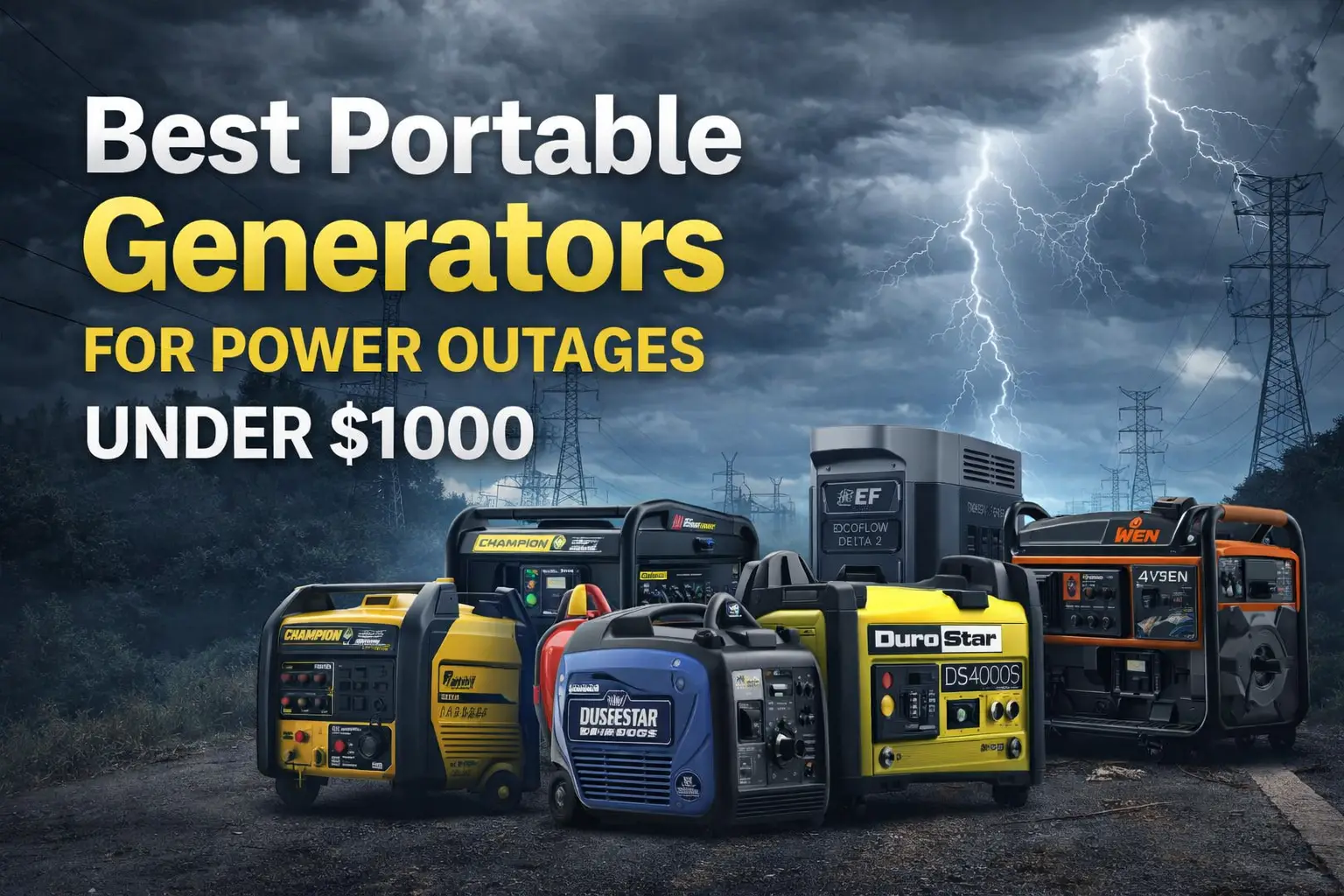
Best Portable Generators for Power Outages Under $1000
Below is our list of the best portable generators for power outages under $1000. Each option delivers reliable backup power to keep essential devices running when the grid is down.
Westinghouse WGen9500DF
This dual fuel generator offers strong power for whole-home backup at an affordable price.
Pros
- Switches between gasoline and propane for fuel flexibility
- Remote start key fob lets you start it from inside your house
- Transfer switch ready outlets make home hookup simple
Cons
- Weighs 210 pounds, so moving it requires effort
- Takes up significant space in your garage or shed
- Noise level at 74 decibels is higher than smaller models
Quick Specs
| Specification | Value |
|---|---|
| Running Watts | 9,500 (gas) / 8,500 (propane) |
| Starting Watts | 12,500 (gas) / 11,200 (propane) |
| Fuel Type | Gasoline or Propane |
| Runtime | Up to 12 hours on 6.6 gallon tank |
The Westinghouse WGen9500DF suits homeowners who want to keep their entire house running during extended outages. It powers your air conditioner, refrigerator, sump pump, and lights at the same time. The dual fuel capability helps if one fuel type runs low or is hard to find.
You can start this generator using a remote key fob, an electric start button, or a recoil cord. The VFT display shows voltage, frequency, and total hours, making it easy to track usage and plan maintenance.
Setup is straightforward with everything included in the box. The battery arrives charged, oil is provided, and the wheels roll smoothly despite the heavy weight. The cast iron engine sleeve increases durability for years of occasional use. GFCI outlets and automatic low oil shutdown protect your appliances and the generator from damage.
Oxseryn 4400W Inverter Generator
This gas-powered generator offers solid performance at a budget-friendly price, making it a good choice if you need reliable backup power without overspending.
Pros
- Weighs only 56 pounds for easy transport
- Runs up to 14 hours in ECO mode at quarter load
- Offers multiple outlet types, including an RV port
Cons
- Produces more noise than some buyers expect
- Choke label may be marked incorrectly, which can confuse users during startup
- Ships without engine oil, so you need to buy oil before first use
Quick Specs
| Running Watts | Starting Watts | Fuel Type | Runtime |
|---|---|---|---|
| 3400W | 4400W | Gasoline | 14 hours at 25% load |
The Oxseryn generator supplies enough power for your refrigerator and other essential appliances during outages. Its 2-gallon fuel tank includes a gauge for easy monitoring. The unit features two standard 120V outlets, a 12V DC port, and an RV connection.
Once you add oil and fuel, starting the generator usually takes just a couple of pulls. The open frame design keeps the weight low, making it easy to lift and move.
The noise level is about 72 decibels from 23 feet away. While not especially quiet, it’s reasonable for an open-frame model at this price. Safety features include low oil shutdown and overload protection. Cold start technology helps ignition in cooler weather.
Your purchase includes a one-year manufacturer warranty. Add oil before your first start, and note that the unit may have a slight gasoline smell from factory testing.
EF ECOFLOW DELTA 2
This portable power station is ideal if you want fast charging and clean indoor operation without dealing with gas or fumes.
Pros
- Charges from empty to 80% in just 50 minutes
- Battery lasts through thousands of charge cycles
- Runs quietly indoors during outages
Cons
- Weighs 27 pounds, which can make moving it harder
- Costs more than traditional gas generators
- Solar panels must be purchased separately for solar charging
Quick Specs
| Feature | Details |
|---|---|
| Capacity | 1024Wh (expandable to 3024Wh) |
| AC Output | 1800W |
| Battery Type | LiFePO4 |
| Weight | 27 pounds |
The DELTA 2 charges faster than most power stations. When the power goes out, you can plug it in and reach 80% charge in under an hour. This speed is helpful when you need backup power quickly.
You get 15 different outlets. The 1800W output supports most household items like refrigerators, TVs, and laptops. This power station runs silently, so you can use it indoors without noise or exhaust.
The battery technology lasts longer than standard lithium batteries. With over 3,000 charge cycles, you can use this power station for years before performance drops. The system protects itself from overcharging and overheating.
If you need more capacity, you can add extra batteries to triple your storage. This feature makes the DELTA 2 useful for longer outages or off-grid trips. The solar charging option lets you stay powered when the grid is down for days.
WEN 4,750-Watt Dual Fuel Generator
This generator offers flexibility to run on either gasoline or propane without exceeding your budget.
Pros
- You can switch between gasoline and propane depending on what’s available during an emergency.
- Electric start lets you operate the generator with a simple turn of the key.
- The voltage selector powers both standard appliances and heavy-duty equipment.
Cons
- Some units have battery issues, which can make the electric start unreliable.
- Customers sometimes receive missing hardware parts upon delivery.
- At over 100 pounds, moving it requires effort even with the wheel kit.
Quick Specs
| Feature | Details |
|---|---|
| Running Watts | 3,800 (gas) / 3,500 (propane) |
| Starting Watts | 4,750 (gas) / 4,350 (propane) |
| Fuel Types | Gasoline and propane |
| Runtime | 11 hours at half load on gas |
The dual fuel option is the main advantage of this WEN model. If propane is easier to find than gasoline during outages, you can switch fuels. The included hose connects directly to standard propane tanks.
This generator offers a variety of outlets for different needs. Two standard household outlets power most appliances, while the twist lock outlet connects to transfer switches for whole-home backup. A DC outlet lets you charge devices like phones directly.
The electric start works well when the battery functions properly, but battery problems affect some units. Plan to check and maintain the battery, as some buyers report dead batteries on arrival or batteries that fail to hold a charge after limited use.
Assembly may be difficult if parts are missing from your shipment. Some customers receive generators without necessary hardware, keys, or manuals. Check everything right after delivery to address issues while the return window remains open.
The engine provides enough power for essential home equipment during outages. You can run your refrigerator, lights, and sump pump without issue on this generator’s output.
Anker SOLIX C1000 Gen 2
This portable power station is a good choice if you want a quiet battery backup that charges quickly and can handle most home essentials during an outage.
Pros
- Recharges to full capacity in under an hour with a standard wall outlet.
- Compact size makes it easy to move between rooms or store under a desk.
- Powers multiple devices at once through ten different ports.
Cons
- The battery design means you can’t refuel with gas during long blackouts.
- Higher price compared to traditional fuel generators in this power range.
- Solar charging requires separate panel purchase.
Quick Specs
| Running Power | Peak Power | Battery Capacity | Recharge Time |
|---|---|---|---|
| 2,000W | 3,000W | 1,024Wh | 49 minutes |
The Anker SOLIX C1000 Gen 2 stands out for its fast recharge time. You can fully charge it in less than an hour using a wall outlet, which is helpful when you need backup power between outages or before storms.
The battery provides enough power to run a refrigerator overnight or keep your home office equipment running during work hours. At 25 pounds, you can move it easily from room to room. Its small footprint allows for convenient storage.
With ten ports, you can plug in several devices at the same time. The unit switches to backup mode in under 10 milliseconds, so sensitive electronics stay powered during transitions.
The battery chemistry is designed to retain most of its capacity after thousands of charge cycles. This durability makes it a solid investment if you face frequent outages or want reliable power for outdoor activities. The app lets you monitor power usage and adjust settings remotely.
Buying Guide
Power Output
Match the generator’s wattage to your needs. Running watts show continuous power output, while starting watts indicate the extra surge needed when appliances start up.
List what you want to power during an outage. Add up their running watts and find the highest starting watts. Choose a generator that exceeds both numbers by at least 10%.
Runtime and Fuel Type
Runtime tells you how long the generator runs on a full tank at half load. Longer runtimes mean fewer refills during extended outages.
Gasoline generators are common and easy to refuel. Propane models burn cleaner and the fuel stores longer. Dual-fuel generators let you use either fuel type.
Portability Features
Check the weight and wheel quality if you need to move the generator. Models under 100 pounds are easier to lift, and larger wheels handle rough terrain better.
A built-in handle makes transportation easier. Some units include a telescoping handle like a suitcase.
Outlets and Features
Count how many outlets you need and what types. Look for multiple 120V household outlets and at least one 240V outlet for large appliances.
Electric start saves effort compared to pull-start models. A fuel gauge helps you monitor gas levels. Low-oil shutdown protects the engine from damage.
Noise Level
Generators usually produce 60-80 decibels. Quieter models around 60 decibels suit residential areas better. Check local noise regulations before buying.
Warranty and Support
Choose a generator with at least a two-year warranty. Some manufacturers offer three years or more. Read what the warranty covers and any maintenance requirements.
Frequently Asked Questions
Choosing the right portable generator requires understanding your power needs, fuel options, and which brands provide the best reliability for your budget. Battery-powered models now compete with traditional gas generators for backup power.
What is the most reliable portable generator for home use within a $1000 budget?
The Champion 4375-Watt Dual Fuel Generator is the most reliable option under $1000. It runs on both gasoline and propane, giving you flexibility during fuel shortages. The dual-fuel system also extends the generator’s lifespan because propane burns cleaner than gasoline.
This generator provides 3500 running watts and 4375 starting watts. You can power essential appliances like your refrigerator, sump pump, and lights at the same time. It runs for 17 hours on a 20-pound propane tank at 25% load.
Champion offers a 3-year limited warranty and has service centers across the country, making repairs easier if problems arise.
Specs:
- Running watts: 3500W
- Starting watts: 4375W
- Fuel type: Gas/Propane
- Runtime: 17 hours (propane at 25% load)
Pros:
- Dual fuel capability adds flexibility
- Electric start with battery included
- Multiple outlets including 120V and 30A RV outlet
- Good warranty coverage
Cons:
- Weighs 122 pounds, making it hard to move
- Louder than inverter models at 68 dBA
Which generator brands should I consider for the best value under $1000?
Champion, WEN, and Westinghouse offer the best combination of price and quality under $1000. These brands provide solid warranties and have proven records for reliability.
Champion specializes in dual-fuel generators for gasoline or propane. Their customer service network covers most states.
WEN focuses on affordable inverter generators that provide clean power for sensitive electronics. Their generators usually cost 20-30% less than comparable Honda models and come with a 2-year warranty.
Westinghouse makes both traditional and inverter generators at competitive prices. They invented the generator in 1904 and bring decades of experience to their designs. Most Westinghouse models include remote start and fuel gauge features.
Generac and Predator (Harbor Freight’s brand) are also worth considering. Generac costs more but offers commercial-grade durability. Predator generators have the lowest prices but shorter warranties.
Avoid off-brand generators sold only online without physical service centers. Getting parts or repairs is difficult if something breaks.
What size portable generator is necessary for a typical home during power outages?
Most homes need between 5000 and 7500 running watts to power essential items during an outage. This range covers your refrigerator, freezer, sump pump, some lights, and a few outlets for charging devices.
Add up the wattage of the items you need most. Refrigerators need 600-800 watts running and 1200-2000 watts starting. Sump pumps require 800-1200 watts running and 1500-3000 watts starting. A furnace fan uses 600-900 watts.
Starting watts are more important than running watts. Motors in refrigerators and pumps need 2-3 times more power to start than to run. Your generator must handle these surges.
A 5000-watt generator works for smaller homes or apartments. You can run essential appliances but may need to rotate which items operate at once. A 7000-watt generator gives more flexibility for larger homes.
Don’t buy more capacity than you need. Generators run most efficiently at 50-75% load. Oversized generators waste fuel and money.
How do battery-powered generators compare to gas generators for home backup needs?
Battery-powered generators (portable power stations) run quietly, are safe for indoor use, and require no maintenance. However, they have limited capacity and cost more per watt. Gas generators provide more power and longer runtime but must be used outdoors and need regular maintenance.
A typical 2000Wh battery station costs $1000-1500 and can power a refrigerator for 10-20 hours. A $500 gas generator with similar output runs for 8-12 hours on one tank and refueling costs $15-20.
Battery stations work best for short outages lasting a few hours. You can use them indoors since they produce no fumes. They start instantly and require no maintenance.
Gas generators are better for extended outages beyond 24 hours. You can quickly refuel them if you have gas available, and they provide enough power to run multiple appliances at once.
Battery stations slowly lose charge during storage, so you need to recharge them every 3-6 months even if unused. Gas generators require stabilized fuel and annual maintenance.
Think about your typical outage length. If power failures in your area last 2-4 hours, a battery station is a good choice. For outages longer than 8 hours, gas generators are usually more practical.
What are the key features to look for in a portable generator for home backup under $1000?
Electric start makes operation easier during emergencies, especially in cold weather. You push a button instead of pulling a cord. Most electric start models under $1000 also include a backup recoil start if the battery dies.
Multiple outlet types give you flexibility for different devices. Look for at least two 120V household outlets, one 120V 30A twist-lock outlet, and USB ports for phones.
Low oil shutdown protects the engine from damage. The generator automatically turns off when oil levels are too low, preventing costly repairs and extending its life.
A fuel gauge or runtime meter helps you plan refueling, so you know exactly when to add gas.
Wheel kits and handles make it easier to move the generator. Most units weigh 80-150 pounds when empty, so you’ll need to move them from storage to where you need power each time you use them.
Consider inverter technology if you need to power laptops or medical devices. Inverter generators produce clean power with less than 3% total harmonic distortion. Traditional generators work well for basic appliances and tools.
Can a portable power station effectively serve as a home backup during outages?
Portable power stations provide reliable backup power for modest needs and short outages. They can run refrigerators, lights, phones, and medical devices for several hours without noise or fumes.
A 1500-2000Wh power station, costing $800-1000, can power a modern refrigerator.