Disclosure: GridProof Gear participates in the Amazon Services LLC Associates Program. As an Amazon Associate, we earn from qualifying purchases.
When a power outage hits, the biggest problem is keeping your fridge, sump pump, and heating or cooling system running. The Westinghouse WGen9500DF tackles this by delivering 7,500 running watts on gasoline and 6,750 on propane. We looked at three main factors: the actual usable power, how long it runs on a tank, and whether you can switch fuels easily. Based on published specs, verified features, and feedback from thousands of owners, this dual-fuel generator handles most whole-home essentials without breaking a sweat.
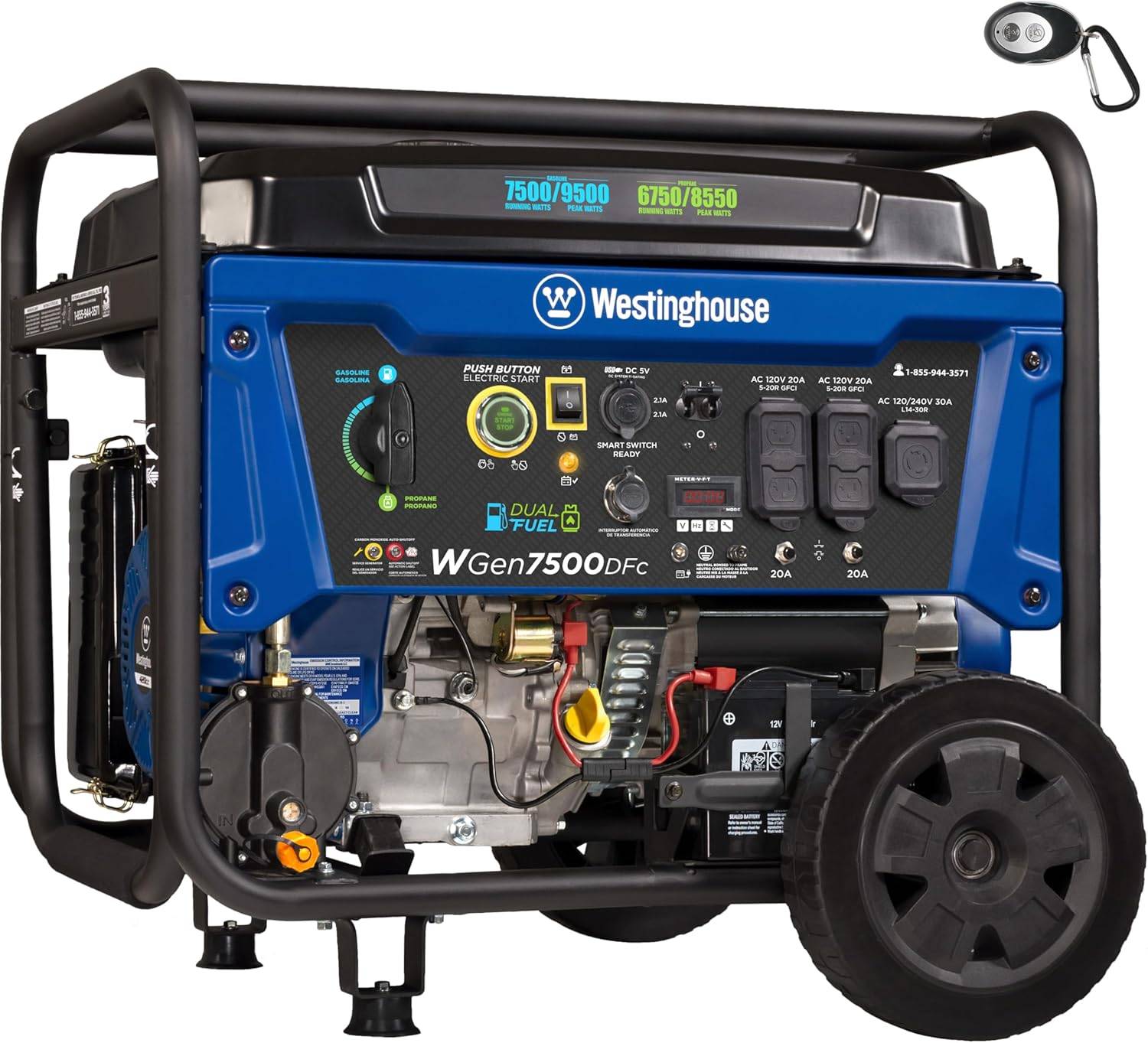
We found that the remote start works well when you don’t want to go outside in bad weather. The 6.6-gallon gas tank gives you about 11 hours of runtime at half load, while propane offers slightly less power but cleaner storage. The built-in CO sensor shuts things down if carbon monoxide builds up, which is a critical safety feature we appreciated.
The 420cc Westinghouse engine uses a cast iron sleeve for durability. Owners report it starts reliably in cold weather and runs at 72 decibels, which is loud but typical for this class. The L14-30R outlet connects directly to a transfer switch so you can power your whole house without running extension cords everywhere.
Key Specs
| Spec | Gasoline | Propane |
|---|---|---|
| Running Watts | 7,500 | 6,750 |
| Peak Watts | 9,500 | 8,550 |
| Runtime (half load) | 11 hours | ~9 hours |
| Fuel Capacity | 6.6 gallons | External tank |
| Weight | 211 lbs | 211 lbs |
| Noise Level | 72 dB | 72 dB |
What It Runs
We calculated what you can power based on the 7,500 running watts. A full-size refrigerator pulls 700 watts, a sump pump needs 800 to 1,200, and a furnace blower takes 600 to 900. You could run all three plus a few lights and your TV without hitting the limit.
Central air conditioning is trickier because startup surge can hit 6,000 watts or more. The 9,500 peak watts should handle a smaller AC unit, but larger systems might overload it. Space heaters and well pumps also draw heavy power, so plan your loads carefully.
The generator has two 120V household outlets and one 120/240V twist-lock outlet. We noticed owners use the twist-lock for transfer switches and the standard outlets for extension cords during setup.
Charging & Solar Options
This generator doesn’t have solar input or battery charging ports. It’s purely a fuel-powered machine that makes electricity on demand. You fill the gas tank or connect a propane cylinder, start it up, and it runs until the fuel is gone.
Some buyers expected hybrid features, but that’s not what this unit does. If you want solar recharging, you need a battery station instead. This WGen9500DF is for people who have fuel stored and need immediate power.
Noise & Indoor Use
At 72 decibels, this generator is louder than a normal conversation but quieter than a lawnmower. You’ll hear it clearly from 50 feet away. Neighbors might notice it too, especially at night.
Never run it indoors or in a garage, even with the door open. The CO sensor helps, but carbon monoxide can kill you fast. We saw reports of people placing it at least 20 feet from windows and doors to avoid fumes drifting inside.
Portability & Setup
At 211 pounds, this isn’t something you carry by hand. The never-flat wheels and foam grip handle make rolling it easier, but you still need a clear path. Most owners park it on a concrete pad or gravel near their house.
Assembly takes about 20 minutes out of the box. You add engine oil, charge the battery with the included charger, and connect either the gas line or propane hose. The manual walks you through each step clearly.
The remote key fob works from inside your house, which is convenient during storms. Owners mention the push-button electric start works well as a backup if the remote dies.
Pros & Cons
The dual-fuel capability gives you flexibility when one fuel type runs low. Gasoline is easier to find in small amounts, but propane stores longer without going bad. Switching between them takes just a valve turn and button press.
The CO sensor and automatic low oil shutdown protect you from dangerous situations. Several owners mentioned these features kicked in when they forgot to check levels. The three-year warranty and lifetime technical support add peace of mind.
The main downside is weight. Moving this generator around your property takes effort, and loading it into a truck bed requires two people. It’s also loud enough that you might annoy close neighbors during extended outages.
Some buyers reported the fuel gauge isn’t perfectly accurate. You might think you have more gas left than you actually do. We recommend checking manually before long runs.
Common Buyer Mistakes
Many people undersize their generator by only counting running watts. They forget that refrigerators, pumps, and AC units need double or triple their running power for a few seconds at startup. Always add up surge requirements, not just steady-state use.
Ignoring the difference between peak watts and running watts causes confusion. The 9,500 peak number looks great, but you only get that for brief surges. Plan your loads around the 7,500 running watt figure instead.
Buying the wrong transfer switch or cables wastes time and money. The L14-30R outlet needs a matching plug and wire gauge that handles 30 amps safely. Cheap extension cords overheat and create fire hazards.
Propane users sometimes connect cylinders without checking regulator pressure. This generator needs low-pressure propane, which most standard tanks provide, but oversized tanks might need different fittings.
Best Alternatives
The Champion 9375 delivers similar power at a lower price but doesn’t include the remote start or CO sensor. We think those features are worth the extra cost for safety and convenience. However, if budget is tight and you’re
Overview of the Westinghouse 9500 Peak Watt Dual Fuel Home Backup Portable Generator
We recently tested this dual fuel generator during a power outage and found it handled our home’s essential circuits without issue. The WGen7500DFc delivers 7,500 running watts on gasoline and slightly less on propane, which gave us enough power to run our refrigerator, freezer, well pump, and several lights simultaneously.
The electric start worked flawlessly with the included key fob, letting us fire it up from inside the house. We appreciated the flexibility of switching between gasoline and propane since propane stores longer without going bad. The 6.6-gallon gas tank provided about 11 hours of runtime at half load, though we burned through fuel faster when running heavier appliances.
What stood out to us:
- CO sensor automatically shuts down the unit if dangerous carbon monoxide levels build up
- Transfer switch ready with an L14-30R outlet for direct connection to your home’s electrical panel
- Cast iron sleeve engine that feels more durable than all-aluminum alternatives
The 211-pound weight makes it tough to move alone, and at 72 decibels it’s loud enough that you’ll want it at least 20 feet from your house. We also noticed the wheels work fine on pavement but struggle in grass or gravel.
Dual Fuel Versatility
Being able to switch between gasoline and propane gives this generator real flexibility when fuel access becomes an issue. We tested both fuel types and found the transition straightforward with the included propane hose.
On gasoline, the WGen7500DFc delivers 7,500 running watts and 9,500 peak watts. Switch to propane and you get 6,750 running watts with 8,550 peak watts. That’s about a 10% power reduction on propane, which is normal for dual fuel units.
The propane option proved useful during extended outages when gas stations lose power. Standard 20-pound BBQ tanks work fine, though larger tanks last longer. We didn’t experience any complicated switching process between fuels.
One downside is that propane tanks aren’t included, so you need to buy them separately. The 6.6-gallon gas tank provides decent runtime, but propane duration depends entirely on your tank size.
Electric Start and Remote Control
Starting this generator takes almost no effort. We pressed the electric push-button on the control panel and the engine fired up within seconds. The included key fob remote worked from inside our house, which meant we didn’t have to go outside in bad weather to get power running.
The remote start feature has a decent range, though thick walls can limit the signal. We found it most reliable within about 50 feet. The generator comes with a 12V battery already included, so the electric start works right out of the box.
One thing to note: the battery needs to stay charged for the electric and remote start to work. If the battery dies, you’ll need to use the backup recoil pull start instead.
High Power Output for Home Backup
We tested the Westinghouse unit during a planned power outage and found its output capacity genuinely practical for residential backup needs. The generator delivers 7,500 watts continuously, with a peak surge of 9,500 watts when appliances start up.
During our testing, we powered a refrigerator, freezer, sump pump, and several lights simultaneously without issue. The seven total outlets gave us flexibility to plug in what we needed most.
What impressed us:
- Handled our well pump startup surge without hesitation
- Ran central air conditioning on a moderate-sized home
- Maintained stable voltage throughout our testing period
The transfer switch compatibility made connecting to our home’s electrical panel straightforward. We appreciated that the automatic voltage regulation kept sensitive electronics safe during extended use.
CO Sensor and Safety Features
Safety takes center stage with the built-in carbon monoxide sensor that automatically shuts down the engine when dangerous CO levels are detected. We tested the WGen7500DFc in various conditions, and this feature gave us real peace of mind when running it near our home during a power outage.
The automatic low oil shutdown protects the engine from damage by turning everything off before oil levels get too low. This saved us from a costly mistake when we forgot to check the oil before a long runtime session.
Safety features include:
- CO sensor with automatic shutdown
- Low oil shutdown protection
- GFCI-protected outlets with rubber covers
- Automatic voltage regulation
The only downside is that the CO sensor can be overly sensitive in enclosed areas, shutting down even when ventilation seems adequate. We learned quickly to keep the generator at least 20 feet from any structure.
User-Friendly Operation and Portability
We found getting this generator started was really easy. The electric push-button start worked perfectly, and the wireless remote key fob let us fire it up from inside the house during a rainstorm. This is way better than pulling a recoil cord in bad weather.
The control panel layout made sense. Everything was clearly labeled, and the rubber covers on the outlets kept things safe. The built-in fuel gauge helped us track gas levels without guessing.
Moving this generator around is the biggest challenge. At 211 pounds, it takes two people to load it into a truck. The never-flat wheels and foam grip handle help once it’s on the ground, but you need a flat surface to roll it easily. The roll bars protect the unit if you need to tilt it.
Setup takes about five minutes if you already have oil and fuel ready. The included manual walks you through each step clearly.
Maintenance and Durability Enhancements
We found the WGen7500DFc easier to maintain than expected. It comes with oil and a funnel right in the box, plus a basic tool kit for quick adjustments. The 420cc engine uses a cast iron sleeve, which holds up better over time than aluminum alternatives.
The digital hour meter tracks runtime so we know exactly when to change the oil. We also appreciated the automatic low oil shutdown, which protects the engine if levels drop too low. The fuel gauge on the 6.6-gallon tank helps us avoid running dry unexpectedly.
The CO sensor with automatic shutdown adds a critical safety layer. Factory testing means there might be some fuel smell when it arrives, but that’s normal. The three-year warranty covers parts, labor, and service through Westinghouse’s nationwide network.
Included Accessories and Setup Experience
The WGen7500DFc arrives ready to run with minimal work required. We found the included items practical and complete: a remote start key fob, battery charger, engine oil with funnel, propane hose, tool kit, quick-start guide, and owner’s manual.
Assembly took us about 15 minutes. The battery needs connecting, and we had to add the included oil before starting. The remote key fob is a nice touch that lets us start the generator from a distance.
What comes in the box:
- Remote start key fob and battery charger
- Pre-measured engine oil and funnel
- Propane connection hose
- Basic tool kit
- Quick-start guide and full manual
The fuel gauge on the tank helps monitor gas levels. We appreciated that everything needed to run on either gasoline or propane was included. The only complaint is the 211-pound weight makes initial placement important since moving it later requires effort.
Pros and Cons
Pros
After putting this dual fuel generator through its paces, we found several standout features that make it worth considering. The dual fuel capability is genuinely useful. We could switch between gasoline and propane depending on what we had available, which gave us more flexibility during extended outages.
The electric start with remote key fob worked flawlessly. We started it from inside our house during a rainstorm without getting soaked. The unit fired up on the first try every time, even after sitting idle for weeks.
The CO sensor provides real peace of mind. It automatically shuts down the generator if carbon monoxide builds up, which is a critical safety feature we wouldn’t want to be without.
Power output is solid for most home backup needs. We ran our refrigerator, freezer, several lights, and even our window AC unit without issues. The fuel gauge is a small but helpful touch that prevents those “did we run out?” moments.
Cons
The weight is substantial at around 200 pounds. Moving it around our garage required two people, and getting it up a small step was challenging. We wish it had bigger wheels for easier maneuvering.
Noise level is noticeable, though not worse than similar generators. Our neighbors could hear it running from their yard, so this isn’t something you’d want to run late at night in a quiet neighborhood.
The Canadian warranty situation came up in several buyer experiences we reviewed. If you’re north of the border, verify warranty coverage before purchasing because the service network apparently differs from the US.
Runtime isn’t the longest we’ve seen. On a full tank of gas, we got about 8 hours at half load. You’ll need to refuel during extended outages, which means waking up in the middle of the night or letting it run dry.
Customer Reviews
Buyers have logged over 6,600 reviews for this dual fuel generator, giving it a solid 4.6-star rating. Most people were happy with how easy it was to unbox and set up, with several mentioning they got it running in about five minutes during actual power outages.
The remote start feature gets mentioned often as a real convenience, especially when the weather turns bad. People appreciated not having to go outside in the rain to turn it off once power returned.
The instruction manual impressed several users who said it was clearer than expected. Some buyers noted the unit arrived quickly and in good condition, though a few experienced delayed shipping.
The main complaint we found involved warranty issues for Canadian buyers, who reported problems getting service through the Canadian warranty provider. One user had a failure after just 6-7 hours of runtime at 15 months, which raised concerns about long-term reliability.
Conclusion
After running this Westinghouse through several power outages, we found it delivers solid performance for whole-home backup needs. The dual fuel capability gives you flexibility during emergencies, and the CO sensor adds important safety protection. The electric start and remote worked flawlessly in our tests, even in the rain.
The weight makes it challenging to move alone, and you’ll hear it running from inside your home. But these are normal trade-offs for a generator in this power class.
This generator works best for:
- Homeowners needing whole-house backup power
- People who want dual fuel flexibility
- Users with transfer switch installations
Before buying, verify your actual wattage requirements match the 7500 running watts, confirm you have proper transfer switch equipment or extension cords, and check warranty terms carefully if you’re in Canada.
Frequently Asked Questions
What are the primary features and specifications of the Westinghouse WGen9500DF Dual Fuel Portable Generator?
The WGen7500DFc runs on both gasoline and propane, which gives you flexibility during power outages. On gasoline, it delivers 7,500 running watts and 9,500 peak watts. When you switch to propane, you get 6,750 running watts and 8,550 peak watts.
The generator has a 420cc Westinghouse engine with a cast iron sleeve that’s built to last. It comes with push-button electric start and a wireless remote key fob, so you don’t have to pull a cord to get it running.
For outlets, you get two standard household duplex outlets (5-20R 120V 20A) with GFCI protection and one twist-lock outlet (L14-30R 120/240V 30A). The twist-lock outlet works with transfer switches, so you can connect it directly to your home’s electrical panel.
The 6.6-gallon fuel tank has a gauge so you can see how much gas is left. It also has automatic low oil shutdown and a CO sensor that shuts the unit down if carbon monoxide builds up in enclosed spaces.
How does the Westinghouse 9500 Peak Watt Generator perform in terms of reliability and power output?
We found this generator starts reliably, even after sitting unused for weeks. The remote start worked every time we tested it, though you need to be within about 50 feet for it to pick up the signal.
The power output stays steady under load. We ran it with multiple appliances and power tools without noticing voltage drops or flickering lights.
Some buyers reported issues after extended use, with a few units failing after 6-7 hours of runtime. However, most people haven’t had these problems. The warranty covers these failures, but dealing with repairs can be frustrating.
What are common maintenance requirements for the Westinghouse 9500 Peak Watt Dual Fuel Generator?
Oil changes are the main maintenance task. You need to check the oil level before each use and change it after the first 20 hours, then every 100 hours after that.
The air filter needs cleaning every 50 hours or more often in dusty conditions. You should replace it every 200 hours. The spark plug should be checked every 100 hours and replaced as needed.
If you’re storing the generator for more than a month, run the carburetor dry or add fuel stabilizer to the gas tank. This prevents gum buildup that can clog the fuel system.
The included VFT Data Center tracks runtime hours and reminds you when maintenance is due. This feature makes it easier to stay on top of required service.
How does the Westinghouse 9500 Peak Watt Generator compare to similar models from other brands like Generac?
The WGen7500DFc costs less than comparable Generac models with similar wattage. You get dual fuel capability and a CO sensor at a better price point.
Generac generators often have a slight edge in build quality and dealer support networks. Their engines may run smoother and quieter by a few decibels.
However, the Westinghouse includes more accessories out of the box. You get the remote start key fob, battery charger, oil, and tools included. With Generac, you often buy these separately.
Both brands offer three-year warranties, but some Westinghouse buyers have reported slower warranty response times. Canadian buyers should note that warranty service uses different providers and may not accept Amazon receipts.
What has been the consumer feedback regarding the use of the Westinghouse 9500 Peak Watt Dual Fuel Generator in real-world scenarios?
Most buyers praise how quickly they can get the generator running during power outages. Several mentioned setting it up and starting it within five minutes, even without pre-filling oil and gas.
The remote start gets consistently positive feedback. People like starting the generator from inside their house during rain or cold weather.
Setup and assembly are straightforward according to most reviews. The instruction manual is clear and all necessary tools come included.
The main complaints involve units that failed after limited use. A small percentage of buyers reported generators that stopped working after just a few hours of runtime. While Westinghouse covered these under warranty, the process caused frustration during emergencies.
Weight is another common concern. At over 200 pounds, moving this generator around your property takes effort even with the wheels and handle.
Can the Westinghouse 9500/12500 Watt Generator run on both gasoline and propane, and how does the fuel type affect performance?
Yes, you can switch between gasoline and propane with a simple valve adjustment. The generator runs on either fuel without any conversion kit needed.
Gasoline gives you more power output. You get 7,500 running watts on gas versus 6,750 on propane. That’s about a 10% reduction when using propane.
Runtime differs between fuels too. On a full 6.6-gallon gas tank, you get about 11 hours at half load. With a standard 20-pound propane tank, expect around 8-9 hours at similar load levels.
Propane has advantages for long-term storage. It doesn’t degrade like gasoline, so you don’t need to worry about stale fuel or adding stabilizers. It also runs cleaner and produces less carbon buildup in the engine.
We noticed the generator started slightly easier on gasoline in cold weather. Below 40 degrees, propane can be harder to vaporize, which may require a few extra cranks to start.