Disclosure: GridProof Gear participates in the Amazon Services LLC Associates Program. As an Amazon Associate, we earn from qualifying purchases.
Power outages happen without warning — and choosing the wrong generator can leave you without refrigeration, internet, or medical power when it matters most. When the lights go out, you need backup power that starts fast and can reliably run essentials like refrigerators, Wi-Fi equipment, and medical devices. Generators fill that role by converting fuel or stored energy into electricity you can use right away.
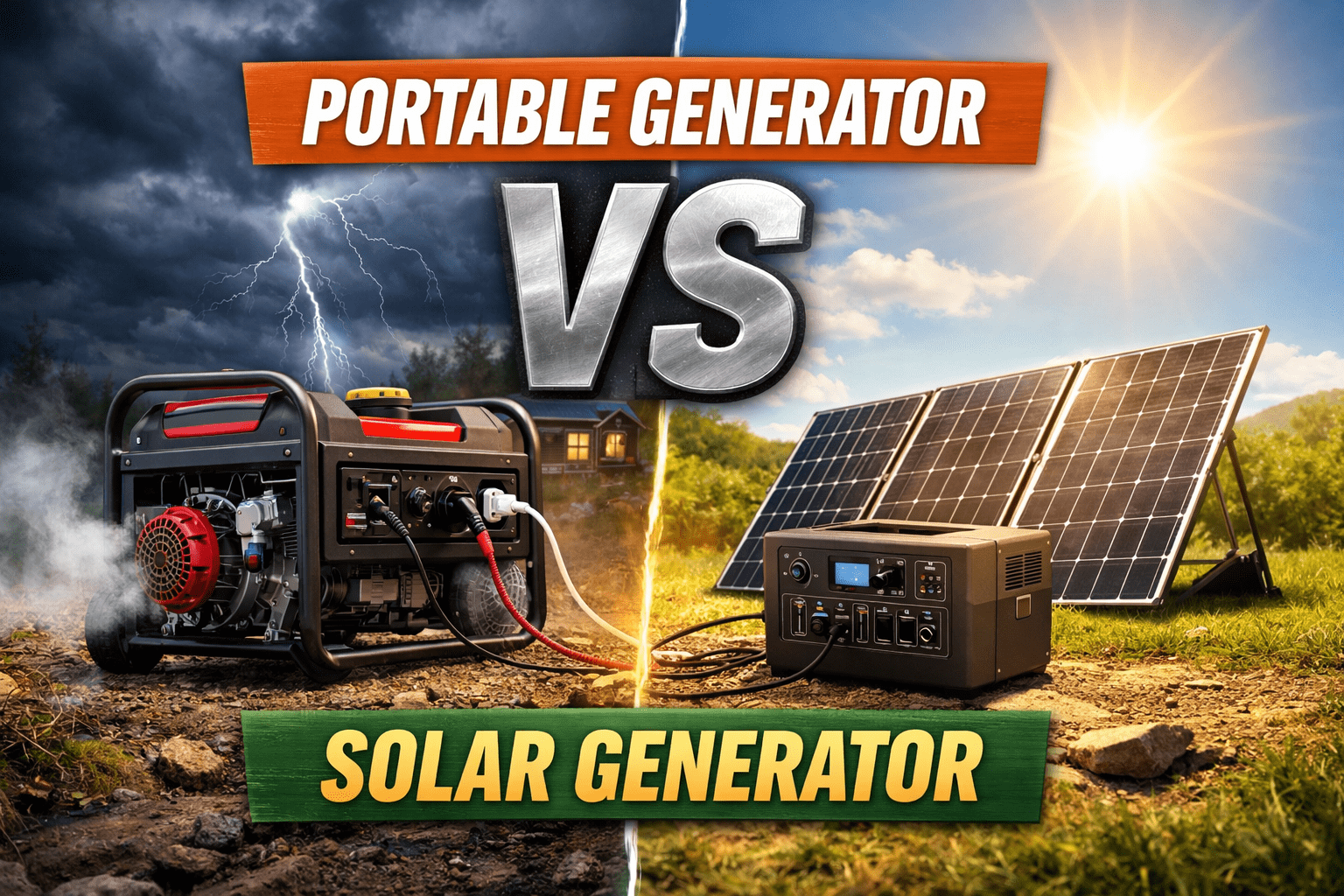
For most homes, backup power comes down to two options: portable gas/propane generators for maximum wattage and long runtimes, or solar generators (battery power stations) for quiet, indoor-safe power. Gas generators typically offer more wattage and longer runtime as long as you have fuel on hand. Solar generators run silently, require no gasoline, and work indoors safely because they produce no exhaust fumes.
The right choice depends on three things: your required wattage, typical outage length, and whether you can safely store fuel and run a generator outdoors. Wattage determines what appliances you can run at once. Runtime depends on fuel capacity or battery size. Noise and exhaust matter if you live in close quarters or need to run the generator indoors. Below, we break down the best options by real-world use case so you can quickly choose the right generator type — without overbuying or coming up short.
Best Portable and Solar Generators for Power Outages
We tested dozens of generators to find the most reliable options for keeping your home running when the power goes out. Our top picks include both traditional portable generators and modern solar-powered models to match different needs and budgets.
Jackery Explorer 300
Best for phones, Wi-Fi routers, laptops, and CPAP machines during short outages — not for refrigerators or other high-draw appliances.
Pros
- Recharges to 80% in just 2 hours when you use both the wall outlet and USB-C port together
- Weighs only 7.1 pounds, making it easy to move around your home or take with you
- Runs quietly with no fumes or gas smell, so you can use it safely indoors
Cons
- The 300-watt limit means this unit is not suitable for refrigerators, microwaves, or heating appliances.
- Solar panel costs extra and isn’t included with your purchase
- Battery might not last through multi-day outages if you’re running several devices
The Jackery Explorer 300 is a simple, indoor-safe way to keep critical electronics powered when the grid goes down. handles smaller electronics without any noise or exhaust.
We like that this unit charges up fast. You can get it ready in about 2 hours using the wall outlet and USB-C port at the same time. The pure sine wave outlets protect your sensitive devices from power surges.
Will it run common devices?
| Device | Estimated Runtime |
|---|---|
| CPAP machine | 6-8 hours |
| LED lights (10W) | 20+ hours |
| Smartphone charging | 15-20 full charges |
| Laptop (60W) | 3-4 hours |
| WiFi router (10W) | 24+ hours |
The six charging ports let you power multiple devices at once. You get two regular AC outlets, one USB-C port that works both ways, a fast-charge USB port, a standard USB port, and a car charger outlet. This setup works well for camping trips or emergency backup.
One thing to watch is the 300-watt limit. You can’t plug in space heaters, coffee makers, or full-size refrigerators. The battery also won’t last as long if you’re charging several things at the same time.
The option to add solar panels gives you more flexibility. You can buy the Jackery SolarSaga 100 separately to recharge during daylight hours. This feature helps extend your power supply during longer outages.
Check today’s price on Amazon if you need backup power for smaller electronics and medical device.
Apowking 300W Solar Generator with 40W Panel
This compact solar generator works best for very short outages when you only need lights, phones, and small electronics.
Pros
- Includes a 40W solar panel in the box so you can recharge without grid power
- Seven different outputs let you charge multiple devices at once without noise
- Lightweight at just 5 pounds makes it easy to move around or take camping
Cons
- The 220Wh battery capacity drains quickly with larger appliances
- Solar charging can be slow and may not work well in cloudy conditions
- Some buyers report battery longevity issues, so we recommend testing it heavily during the return window.
The Apowking bundle gives you everything needed to start using solar power right away. The included 40W panel connects directly to the power station and can recharge the battery when the sun is out. At 220Wh capacity, this unit handles phones, tablets, and small electronics without issue.
We like that this model offers pure sine wave AC outlets, which protect sensitive electronics better than modified sine wave inverters. The 300W continuous power output works for smaller items, though the 600W peak helps when devices need a startup surge. Seven ports mean you can charge several gadgets simultaneously.
The built-in LED light panel covers the entire back of the unit. This feature proves useful during nighttime outages or camping trips when you need hands-free illumination.
Will it run common devices?
- LED lights: Yes, for many hours
- Phone charging: Yes, 15-20 times
- Laptop: Yes, 2-3 charges
- Small fan: Yes, for several hours
- Coffee maker: No, draws too much power
- Full-size refrigerator: No, exceeds capacity
Keep in mind the battery won’t power hungry appliances like space heaters or full refrigerators. The 300W limit means you need to choose what runs carefully. Several customer reviews mention the solar panel charges slowly, so don’t count on quick recharges during partly cloudy days.
The compact size makes storage simple, but that small footprint comes with limited battery capacity. You’ll get through a short outage fine, though multi-day power losses might require rationing your usage or having backup charging methods ready.
Check today’s price on Amazon if you want a low-cost, entry-level solar backup for lights and electronics and understand the limitations.
BLAVOR S1600 Solar Power Station
This solar generator is best for homeowners who want meaningful backup power without gas, noise, or exhaust.
Pros
- The built-in fold-out solar panel is convenient for topping off the battery, but external panels are strongly recommended for outage preparedness.
- LiFePO4 battery lasts over 10 years with regular use
- Runs most household devices with 1600W output and eight different outlets
Cons
- Weighs 26 pounds which makes it harder to carry around
- Built-in solar panel only provides 40W so recharging takes a while
- No traditional 12V car socket included
Why It’s a Fit
- The 1024Wh battery capacity gives you several hours of power for essential devices during blackouts
- Eight different outlet types let you plug in multiple devices at once without needing adapters
- Four charging options mean you can power it back up through your wall outlet, car, or solar panels
- LCD screen shows exactly how much battery remains so you won’t run out unexpectedly
- Advanced battery technology keeps working reliably even after thousands of charge cycles
- Quiet operation means you can use it indoors without the noise and fumes of gas generators
Watch-Outs
- The 40W solar panel works slowly on its own and takes much longer to fully recharge compared to wall charging
- At 26 pounds this unit feels heavy when you need to move it around frequently
- You’ll need to buy extra solar panels if you want faster solar charging speeds
Will It Run Common Devices?
| Device | Estimated Runtime |
|---|---|
| Refrigerator (150W) | 6-7 hours |
| WiFi Router (20W) | 50+ hours |
| CPAP Machine (40W) | 25+ hours |
| LED Lights (10W each) | 100+ hours per bulb |
| Coffee Maker (1000W) | About 1 hour |
| Laptop (65W) | 15+ hours |
The 1600W power output handles most home appliances during an outage. We found the surge capacity of 3200W useful for starting up devices that need extra power when they first turn on. Coffee makers and refrigerators both work without issues.
The fold-out solar panel design won a 2022 design award for good reason. It stores flat against the unit and flips open when you need it. This setup eliminates the hassle of carrying separate panels and cables.
However, that built-in panel only provides 40W of charging power. Solar-only charging works best for gradual recharging; wall charging or larger external panels are far faster for outage prep. Wall charging through an outlet works much faster for emergency prep.
The LiFePO4 battery technology stands out from standard lithium batteries. These cells last through 3500+ charge cycles while keeping 80% of their capacity. That translates to more than a decade of regular use.
Eight outlets cover different needs. You get standard AC plugs for household items, USB ports for phones and tablets, and a 100W USB-C port that charges laptops quickly. The USB-C port also works in reverse to recharge the station itself.
The battery management system prevents common safety issues. It stops the unit from overheating, getting overloaded, or short circuiting. This protection matters when you’re running multiple devices at once.
At 26 pounds this generator requires two hands to move comfortably. The fixed handle helps but you won’t want to carry it long distances. Plan to set it up in one spot during outages.
Check today’s price on Amazon if you want indoor-safe backup power that can run more than just phones and lights. This unit fits homes that experience occasional outages and campers who need reliable power away from electrical hookups.
Jackery Solar Generator 300
This bundle works best for electronics and medical devices during short outages or camping trips where quiet, fume-free power matters.
Pros
- Charges back up fast through wall outlets in about 2 hours or through the included solar panel
- Runs quietly with no maintenance needed and produces no exhaust
- Lightweight at just over 7 pounds so you can move it easily
Cons
- This bundle is best for electronics and CPAP machines, not refrigerators, coffee makers, or other high-draw appliances.
- Battery capacity of 293Wh only provides enough energy for smaller loads over short periods
- Solar panel and power station ship separately which may cause delivery confusion
The Jackery Solar Generator 300 bundle gives you both a portable power station and a 100-watt solar panel in one package. This setup handles short power outages when you need to keep phones charged and essential medical devices running. The pure sine wave output protects sensitive electronics from power surges.
We like how this unit offers six different charging ports. You get two standard AC outlets plus USB-A, USB-C, and car charging options. This variety lets you charge multiple devices at once without needing extra adapters.
Will It Run Common Loads?
- CPAP machine: Yes, for 8+ hours
- Phone charging: Yes, 4-6 full charges
- LED lights: Yes, for multiple days
- Laptop: Yes, several charges
- Mini fridge: No, too much draw
- Full-size refrigerator: No, exceeds capacity
The solar charging works well when the sun is out. The MPPT controller helps the panel work at full capacity to refill the battery faster. Still, cloudy days will slow down solar charging significantly.
The 293Wh capacity means you need to think carefully about what you plug in. Medical devices like CPAP machines run fine through the night. Small fans and phone chargers work without issues. But this unit won’t run space heaters, coffee makers, or power tools.
Recharging from a wall outlet takes only 2 hours to reach 80% capacity. This quick recharge time helps during rolling blackouts where power comes back for short periods. You can top off the battery fast between outages.
The plastic case keeps the weight down but may not survive rough handling. We recommend storing it safely when not in use. The controls are simple with clear indicators showing battery level and power output.
Check today’s price on Amazon if you want a simple, plug-and-play backup solution for electronics and short outages. This bundle makes sense for people who want clean, quiet power without dealing with gas and engine maintenance.
Jackery Explorer 1000 v2
The Jackery Explorer 1000 v2 is best for users who want quiet, indoor-safe power for refrigerators and essentials during short-to-medium outages.
Pros
- Charges from empty to full in just one hour when using the emergency mode through the app
- The battery lasts over 10 years with more than 4,000 charge cycles before dropping below 70% capacity
- Weighs only 23.8 pounds with a folding handle that makes it easy to carry around
Cons
- Solar panels cost extra and are not included with the power station
- Solar charging is simplest with Jackery panels; confirm connector compatibility before using third-party options.
- Like all battery-based systems, runtime drops quickly when powering higher-draw appliances.
This solar generator puts out 1,500 watts of continuous power and can handle 3,000 watts for short bursts when appliances first start up. The unit comes with seven total outlets including two USB-C ports, one USB-A port, three standard AC outlets, and one car port. All these options let you charge multiple devices at the same time without needing extra adapters.
The fast charging feature stands out as a major benefit during emergencies. We appreciate that you can control the charging speed through the Jackery app to balance between quick power-ups and keeping the battery healthy for longer. The default 1.7-hour charge time protects the battery better than always using the one-hour emergency mode.
Will It Run Common Devices?
| Device | Estimated Runtime |
|---|---|
| Mini fridge (60W) | 15-17 hours |
| WiFi router (10W) | 100+ hours |
| CPAP machine (30W) | 30-35 hours |
| LED lights (10W each) | 100+ hours |
| Electric blanket (50W) | 20 hours |
The LiFePO4 battery technology provides better safety and longer life compared to older lithium-ion models. This battery type handles more charge cycles and works better in different temperatures. The pure sine wave output protects sensitive electronics like laptops and medical devices from power surges.
One limitation involves the solar charging compatibility. You must buy Jackery’s own solar panels if you want to charge from the sun. This restriction limits your options and could cost more than using universal panels. The unit also lacks some expansion features that other brands offer for connecting multiple batteries together.
The 1,070Wh capacity provides enough power for weekend camping or backing up essential devices during short outages. It won’t run your whole house but handles critical items like phones, laptops, a small fridge, and medical equipment. The quiet operation makes it suitable for indoor use unlike noisy gas generators.
Check today’s price on Amazon if you want indoor-safe backup power that can realistically replace a small gas generator for essentials.
Buying Guide
Power Output Matters Most
We recommend starting with your power needs. Add up the wattage of every device you want to run during an outage. Refrigerators typically need 700-800 watts, while laptops use around 50-100 watts.
Portable generators deliver far more wattage and runtime, while solar generators trade peak power for indoor safety, silence, and zero fuel storage.
Runtime and Fuel Considerations
For portable generators, we look at fuel tank size and consumption rate. A generator that burns through fuel quickly will cost more to run and require frequent refills. See portable generator options on Amazon.
Solar generators depend on battery capacity measured in watt-hours. A 1,000Wh battery running a 100-watt device lasts about 10 hours. See top-rated solar generators on Amazon.
Portability and Weight
Check the weight if you need to move the unit. Portable generators with wheels are easier to position outside. Browse portable generators with wheels. Solar generators are often lighter but watch for battery size increasing weight significantly. Shop lightweight solar generators.
Noise Levels
We measure this in decibels. Portable generators range from 50-70 dB at normal load. Find quiet portable generators. Solar generators produce zero noise during operation. Silent solar generator options.
Recharging Options
Solar generators need sunlight or wall outlets to recharge. Look for units accepting multiple panel connections for faster charging. Explore solar generators with fast recharge. Portable generators create their own power but need fuel storage and access. See portable generator fuel options.
Safety Features
We check for automatic shutoff, overload protection, and proper ventilation requirements. Portable generators produce carbon monoxide and must always be operated outdoors, away from doors and windows. Generators with safety features. Solar generators can operate safely indoors. Browse indoor-safe solar generators.
Expansion Capability
Some solar generators accept additional batteries to extend runtime. Solar generators with expandable batteries. Portable generators cannot expand capacity beyond their engine size.
Frequently Asked Questions
People often ask about power output, fuel costs, noise levels, and how long each generator type can run during an outage. We’ll cover the main advantages and drawbacks of both options to help you decide which works best for your situation.
What are the pros and cons of using a solar generator for emergency power outages?
Solar generators offer clean, quiet power without fuel costs or emissions. They work well for short outages when you need to run essential devices like phones, laptops, and medical equipment. See emergency solar generators.
Pros:
- No ongoing fuel costs once you buy the unit
- Silent operation won’t disturb neighbors or wildlife
- Safe to use indoors without ventilation concerns
- Low maintenance with no oil changes or spark plugs
- Can recharge during daylight hours while running devices
Watch-outs:
- Cloudy weather and nighttime severely limit recharging ability
- Higher upfront cost than comparable portable generators
- Limited power output for high-draw appliances like electric heaters
Will it run common loads?
- Mini fridge (100W): Yes, 8-24 hours depending on battery size
- WiFi router (20W): Yes, 2-4 days continuously
- CPAP machine (60W): Yes, 1-2 nights per charge
- LED lights (10W each): Yes, multiple days
We recommend solar generators for people who experience brief outages and want a maintenance-free backup option. Check today’s price on Amazon if you prioritize quiet operation and don’t need to power heavy appliances.
How does a portable generator compare to a solar generator in terms of efficiency and reliability during outages?
Portable generators deliver more consistent power output regardless of weather conditions. They can run as long as you have fuel available. Browse reliable portable generators.
Gas-powered portable generators typically convert 15-20% of fuel energy into electricity. Solar generators convert 18-22% of sunlight into stored power, but weather dependency affects their practical reliability. A portable generator produces 3,000-7,000 watts continuously, while most solar generators max out at 1,000-2,400 watts. Compare solar generator wattages.
Reliability factors:
- Portable generators work in any weather, day or night
- Solar generators need 6-8 hours of sun for a full recharge
- Gas generators require fuel storage and regular maintenance
- Solar units have fewer mechanical parts that can fail
During extended outages lasting more than 2-3 days, portable generators prove more reliable. You can refuel them in minutes, while solar panels may take a full day to recharge batteries. Solar generators work better for planned power needs when you can charge them before an outage hits.
Which type of generator offers the most sustainable energy solution for residential homes during power cuts?
Solar generators provide the most sustainable option because they use renewable energy and produce zero emissions. They eliminate the need for gasoline storage and reduce your carbon footprint to zero during operation. See sustainable solar generators.
A typical 2,000-watt portable generator burns through 1-2 gallons of gas every 8 hours. Over a year with monthly outages, that adds up to 24-48 gallons of fuel and roughly 500 pounds of CO2 emissions. Solar generators avoid these environmental costs entirely after manufacturing. See fuel-efficient portable generators.
Long-term sustainability factors:
- Solar panels last 25-30 years with minimal degradation
- Lithium batteries need replacement every 8-12 years
- No fossil fuel consumption or emissions during use
- Quiet operation reduces noise pollution in neighborhoods
The upfront environmental cost of manufacturing solar panels and batteries gets offset within 2-4 years of use. Portable generators continue producing emissions throughout their lifespan. We find solar generators make sense for environmentally conscious homeowners who can afford the higher initial investment. Shop solar backup systems for homes.
Can a solar generator provide sufficient power for essential appliances in a home outage scenario?
Solar generators can power essential appliances, but you need to match the unit’s capacity to your specific needs. Most mid-range solar generators handle basic necessities like refrigerators, lights, and communication devices. Check best-selling solar generators.
What you can typically run:
- Full-size refrigerator (150-200W): 8-16 hours on a 1,500Wh unit
- 5 LED bulbs (50W total): 24-30 hours
- Phone and laptop charging (50W): 20+ full charges
- Small TV (100W): 12-15 hours
- Box fan (75W): 18-20 hours
What won’t work well:
- Central air conditioning systems
- Electric water heaters
- Well pumps over 1/2 HP
- Electric stoves or dryers
A 2,000-watt solar generator with 2,000Wh battery capacity costs $1,500-2,500. It handles a refrigerator, several lights, phones, and a laptop simultaneously for 6-10 hours. You’ll need to prioritize which devices matter most during outages. See 2,000W solar generators.
We recommend calculating your essential power needs before buying. Add up the wattage of must-have devices and multiply by how many hours you need them running. This tells you the minimum Wh capacity required.
For RV and camping needs, what are the advantages of solar generators over traditional portable generators?
Solar generators excel in RV and camping situations where noise restrictions apply and you want multi-day power without resupply trips. They’re lightweight, compact, and perfectly suited to outdoor recreation needs. See RV-ready solar generators.
Why they fit RV and camping use:
- National and state parks often ban gas generators or restrict hours
- No fuel storage concerns in hot vehicles or tents
- Recharge while hiking or exploring during the day
- Weighs 20-50 pounds less than equivalent portable generators
- Can mount solar panels on RV roof for automatic charging while driving
- Safe to run inside RVs and campers without ventilation
Watch-outs:
- Dense forest canopy limits solar charging effectiveness
- Winter camping provides fewer daylight charging hours
- Can’t run high-power appliances like RV air conditioners
- Takes longer to recharge than refueling a gas tank
Common camping loads:
- Electric cooler (50W): 20-40 hours
- Phone/tablet charging: 15-25 full charges
- Portable fan (30W): 30-50 hours
- LED camping lights (20W): 50-100 hours
- 12V water pump (40W): 25-40 hours
Check today’s price on Amazon if you camp frequently in locations with generator restrictions or want hassle-free power for electronics and small appliances. These work best for weekend warriors and extended trips in sunny climates.