Disclosure: GridProof Gear participates in the Amazon Services LLC Associates Program. As an Amazon Associate, we earn from qualifying purchases.
Power outages and rising energy costs make solar batteries sound like whole-home, run-forever solutions. That assumption is wrong — and it’s the fastest way to overspend or end up disappointed when the lights go out.
In real-world use, most homes get 8 to 24 hours of backup power from a solar battery, depending on battery capacity (watt-hours) and which appliances you keep running during an outage. Smaller batteries cover essentials like lights and Wi-Fi, while larger systems extend runtime only with load control.
This guide breaks down real-world solar battery runtime using common household loads — not lab math or marketing claims. You’ll also see practical references to widely available solar battery systems so you can compare realistic options and plan backup power that actually works.
Real-World Solar Battery Runtime Examples (What You Can Actually Power)
~1000Wh Battery Capacity
A ~1000Wh solar battery can keep a refrigerator running for 6–8 hours, maintain Wi-Fi all day, power several LED lights overnight, and handle multiple phone charges.
High-draw appliances like space heaters or air conditioners overwhelm this size quickly and can drain the battery in under an hour, making load control essential
Recommended for short outages and essential loads: EcoFlow Delta 2
👉 Check current price on Amazon
~2000Wh Battery Capacity
A ~2000Wh solar battery can keep a refrigerator running for 12–18 hours while supporting Wi-Fi, overnight LED lighting, and phone or laptop charging with room to spare.
High-draw appliances still reduce runtime quickly and should be avoided during outages.
Recommended for full-day essential backup: BLUETTI AC200L or AC200MAX
👉 Check current price on Amazon
~3000–3600Wh Battery Capacity
At this size, you can power a refrigerator for about 24 hours, maintain Wi-Fi, run LED lights overnight, and handle steady phone charging with margin. High-draw appliances still cut runtime fast, often within 3–5 hours.
Recommended for one-to-two days of essential backup: Anker SOLIX F2000 or Jackery Explorer 2000 Plus
👉 Check current price on Amazon
How Long Can a Solar Battery Power Your Home?
Solar battery runtime depends on battery size, daily energy use, and which appliances you keep running during an outage. Most residential solar batteries store energy in kilowatt-hours (kWh), and small changes in appliance use can shift backup duration by many hours.
Typical Backup Durations in Real-World Scenarios
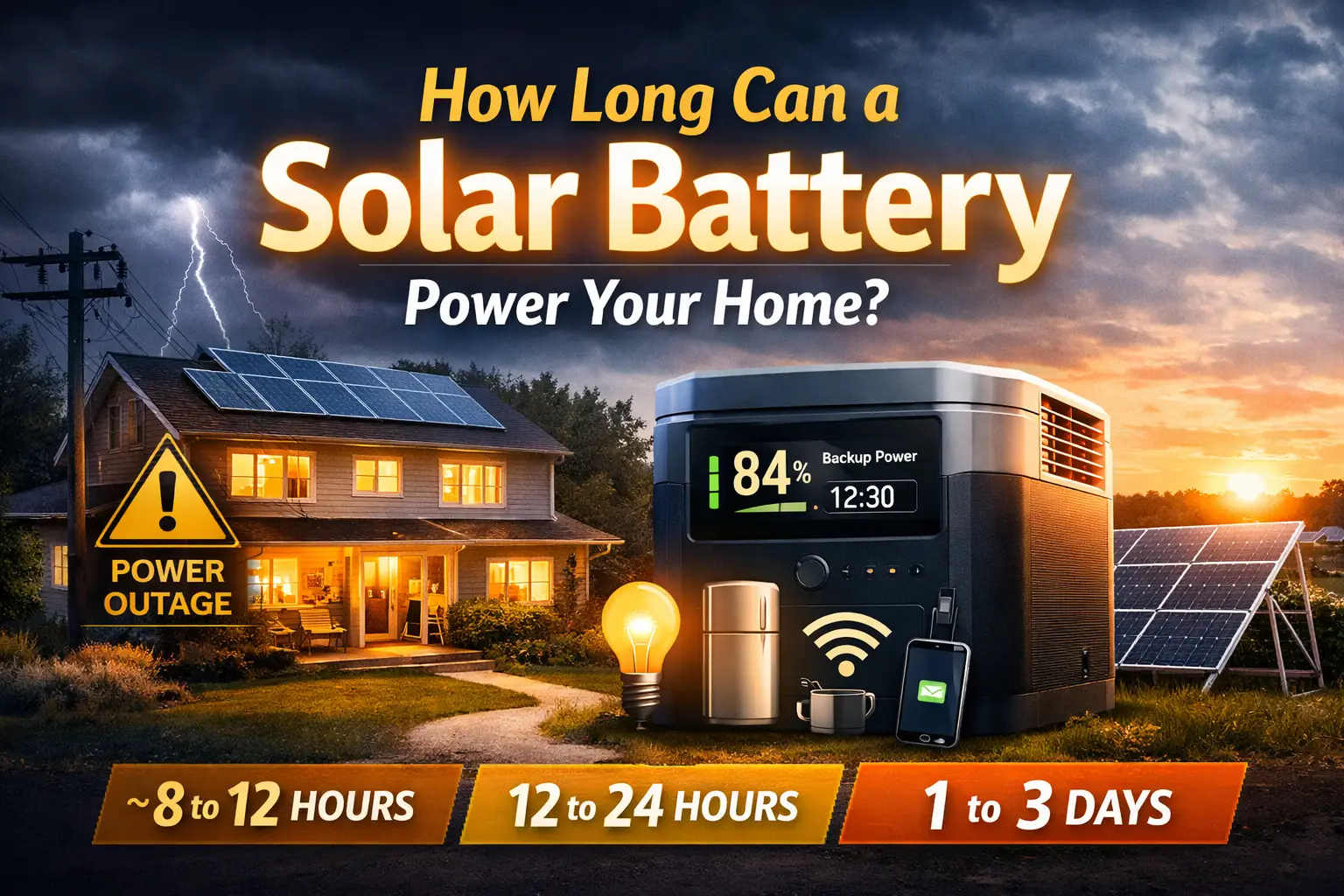
During a power outage, a 10 kWh battery often supports basic home backup for about 12 to 24 hours. This range assumes you power only essential loads and avoid heavy use.
If you add solar panels, daytime production can extend runtime. Cloudy weather lowers output, so stored energy still matters.
Homes with multiple batteries often reach 2 to 3 days of backup. The exact time depends on how steady your energy use stays during the outage.
How Appliance Choices Affect Runtime
What you run matters more than the battery itself. A refrigerator may use 1–2 kWh per day, while LED lights and a Wi‑Fi router use far less.
High-draw devices drain batteries fast. Space heaters, electric stoves, and air conditioners can pull 1–4 kW nonstop, cutting battery runtime to just a few hours.
You extend battery runtime by limiting use to lights, food cooling, internet, and charging. This approach answers the common question, how long can a solar battery power your house, with realistic expectations.
Average Battery Sizes and Their Backup Capability
Most residential solar batteries fall between 9 and 13.5 kWh. A single unit usually covers essential home backup, not whole-home comfort.
| Battery Size | Typical Backup Use | Expected Duration |
|---|---|---|
| 5–7 kWh | Lights, Wi-Fi, refrigerator | 8–12 hours |
| 10 kWh | Essential circuits only | 12–24 hours |
| 20+ kWh | Larger homes (controlled loads) | 1–3 days |
Runtime assumes strict load control and excludes electric heating, electric cooking, or central air conditioning.
Adding batteries increases backup duration more reliably than oversizing one unit.
Expandable Systems (Multiple Batteries)
Expandable systems let you stack batteries to reach 10 kWh or more, supporting essential home backup for 1–3 days depending on how carefully loads are managed.
High-draw devices still reduce backup duration, even with large capacity. Load control stays critical.
Recommended for multi-day essential backup with future expansion: EcoFlow Delta Pro (with expansion battery support)
👉 Check current price on Amazon
Key Factors That Determine Battery Power Duration
Your solar battery runtime depends on how much energy the battery stores, how quickly your home uses that energy, and how much power your system can deliver at one time. Sunlight and solar panel output also play a direct role when the battery can recharge during the day.
Battery Storage Capacity and Depth of Discharge
Battery capacity, measured in kWh, sets the maximum energy you can store. A 10 kWh battery can supply 10 kWh of usable energy only if the system allows full access.
Most batteries limit how much energy you can use through depth of discharge (DoD). Many lithium-ion batteries allow 80–90% DoD. That means a 10 kWh battery may give you 8–9 kWh in real use.
Usable capacity matters more than total capacity. Always check the rated DoD and expected losses from inverter efficiency, which often reduce output by 5–10%.
Household Energy Consumption Patterns
Your energy usage patterns control how fast the battery drains. Homes that use 20–30 kWh per day will empty a single battery much faster than homes that use 8–12 kWh per day.
Focus on essential loads during outages. These often include a refrigerator, lights, internet, and phone charging. Cutting out electric heating, cooling, and laundry can reduce power consumption by more than half.
Track your kWh per day from utility bills or monitoring apps. This gives the clearest estimate of how long your battery will last.
Continuous and Peak Power Requirements
Battery runtime also depends on continuous power and peak power limits. Continuous power is what the battery can supply steadily. Peak power covers short surges, like when a refrigerator compressor starts.
If your inverter cannot handle peak loads, devices may not run at all. Many home batteries supply 5–7 kW of continuous power, with higher short-term peaks.
High peak demand drains batteries faster. Several large loads running at once can cut runtime sharply, even if total energy use seems low.
Solar Panel Output and Sunlight Availability
Solar panels extend runtime by recharging the battery during the day. Output depends on system size, weather, and peak sunlight hours.
A 5 kW solar system may produce 20–25 kWh on a sunny day but far less during clouds or winter. If panels recharge faster than your home uses energy, the battery can last much longer.
Charge rate also matters. Limited sunlight or shaded panels slow charging, which reduces how much backup power you get during long outages.
Types of Solar Batteries and Their Performance
Solar battery performance depends on battery chemistry, usable capacity, and how often you cycle the battery. These factors also affect which battery models make sense for backup power versus portability. These factors affect how long your battery powers your home and how many years it lasts.
Lithium-Ion Batteries: Advantages and Limitations
Lithium-ion batteries dominate home solar systems today. They store more energy in less space and deliver steady power. Many home energy storage systems use lithium-ion battery chemistry with built-in safety controls, while portable solar batteries use similar lithium technology in modular formats.
These batteries handle deep charge cycles well. You can use 80–90% of their capacity without damage. Most offer 3,000–6,000 charge cycles, which supports a 10–15 year battery lifespan.
A battery management system controls heat, charging, and discharge. This improves solar battery performance and safety. The main limit involves cost. Lithium-ion batteries cost more upfront than other options, but they last longer and need little maintenance.
Lead-Acid and Flow Batteries: Comparisons
Lead-acid batteries cost less and use older technology. You see them in off-grid cabins and backup systems. They include flooded and sealed versions.
These batteries require regular care and ventilation. You should only use about 50% of capacity to avoid damage. Most last 500–1,500 charge cycles, which shortens solar battery life.
Flow batteries use liquid electrolytes stored in tanks. They last longer than lead-acid batteries and handle deep cycles well. Flow batteries work best for large systems. Their size, cost, and complexity make them rare for homes.
| Battery Type | Typical Cycle Life | Maintenance |
|---|---|---|
| Lead-acid battery | 500–1,500 | High |
| Flow batteries | 5,000+ | Low |
Battery Chemistry, Cycle Life, and Lifespan
Battery chemistries control how long a system lasts and how it performs. Lithium iron phosphate (LFP) offers better heat tolerance and longer cycle life than older lithium-ion batteries.
Cycle life measures how many full charge cycles a battery can complete. One cycle equals using 100% of stored energy, even across several partial uses.
Battery lifespan drops faster with deep daily cycling and high heat. Good system design and a quality battery management system help protect your investment and extend solar battery life.
Optimizing Solar Battery Runtime in Your Home
You can dramatically extend solar battery runtime with smart load choices, efficient devices, and basic system care. Smart controls, clean usage habits, and grid support all play a role in how long your backup power lasts during outages.
Managing Essential Loads and Smart Controls
You get the most runtime when you control what draws power. Start with load management and focus on essentials like the refrigerator, Wi‑Fi, and lights.
An energy management system (EMS) helps you set rules. You can pause non‑essential circuits and protect your home solar battery during an outage. Smart panels and plugs make this easy.
Use scheduled charging and discharge limits. These settings reduce waste and protect battery storage capacity. During outages, switch to manual control to avoid surprise drains.
Energy-Efficient Appliances and Usage Habits
Efficient devices lower daily energy use and extend backup time. Choose Energy Star appliances and replace old bulbs with LED lighting.
Simple habits matter. Run the dishwasher during sunny hours. Charge phones and laptops in short sessions. Turn off devices you do not use.
Small loads add up. A modern fridge may use 1–2 kWh per day, while LEDs use only a few watts each. These choices help your solar energy system deliver longer backup power during outages.
Extending Battery Life and System Maintenance
Good battery maintenance protects performance and helps extend battery life. Keep batteries within the recommended temperature range.
Avoid deep discharges when possible. Most lithium home energy storage systems last longer when you stop at 80–90% depth of discharge.
Check software updates after battery installation. Updates improve safety and accuracy. Inspect cables and vents once or twice a year to keep your battery backup reliable.
The Role of Net Metering and Grid Support
Net metering lets you send excess solar power to the grid and draw it back later. This support reduces battery cycling and wear.
When the grid is up, let it handle heavy loads. Save solar energy storage for nights and outages. This balance boosts energy independence without stressing your system.
Some utilities allow partial backup. You can blend grid power with solar and battery support to keep critical loads running longer.
Frequently Asked Questions
Solar batteries provide reliable backup power when expectations match reality. Most systems are designed to run essentials — not entire homes — and runtime depends heavily on load control.
Choosing the right battery size means balancing capacity, appliance use, and how easily the system can expand as your needs grow. The products referenced above represent realistic, widely available systems that match common backup needs.
👉 Check current prices on Amazon to compare solar batteries that match real-world usage, not marketing promises.
What is the typical lifespan of a residential solar battery?
Most home solar batteries last 10 to 15 years. You can expect 3,000 to 6,000 charge cycles before capacity drops.
Heat, deep daily use, and poor ventilation can shorten battery life.
How many hours of backup power can a solar battery provide?
A 10 kWh battery can run basic needs for about 24 hours if you limit usage. Heavy loads reduce that time fast.
You get more hours by powering only essentials like a fridge, lights, and Wi‑Fi.
What factors influence the efficiency and output of a home solar battery?
Battery size, inverter quality, and your energy use matter most. Running fewer devices increases usable runtime.
Temperature also affects output. Batteries work best in mild conditions.
Can a solar battery power a house during a blackout?
Yes, if your system includes a battery and a backup inverter. The system must disconnect from the grid for safety.
You usually power selected circuits, not the entire house.
What is the average capacity of a solar battery for home use?
Most home batteries store 9 to 13 kWh. Smaller portable systems range from 1 to 4 kWh.
Larger homes often use more than one battery.
How does weather affect the performance of a solar battery system?
Cloudy weather reduces solar charging during the day. The battery still works but may recharge slower.
Cold weather can lower output. Extreme heat can reduce battery lifespan.