Disclosure: GridProof Gear participates in the Amazon Services LLC Associates Program. As an Amazon Associate, we earn from qualifying purchases.
If you’re powering a home, RV, or jobsite with a portable generator, the extension cord is a safety component—not an accessory. The wrong cord can cause voltage drop, overheating, melted plugs, nuisance breaker trips, damaged appliances, or (worst case) a fire.
The right cord does three things:
- Matches your generator outlet (L14-30 vs L14-50 is the big one)
- Uses enough copper for the distance (wire gauge + length prevents heat/voltage drop)
- Survives outdoor use (STW/SJTW/SJOOW jacket + molded strain relief)
60-Second Cord Chooser (Buy the Right One Fast)
Step 1 — Check your generator outlet:
- L14-30 (30A, 4-prong twist-lock) = most portable generators (typical “home backup” setup)
- L14-50 (50A, 4-prong twist-lock) = larger generators / RV-style 50A inlets
Step 2 — Pick your length (shorter is safer): 25 ft is ideal → 50 ft is common → 75–100 ft only if you must
Step 3 — Match copper to distance:
- 30A (L14-30): 10/3 for 25–50 ft; 8/3 preferred for 75–100 ft
- 50A (L14-50): 8/3 for 25–50 ft; 6/3 preferred for longer runs / heavy loads
Quick picks:
- Best Overall (most homes): 30A L14-30, 10/3, 25–50 ft, STW/SJTW
- Best for whole-home/RV inlets: 50A L14-50, 8/3 or 6/3, STW/SJOOW
- Best “budget” (still safe): 30A L14-30, 10/3, 25 ft (budget = shorter, not thinner copper)
- Best long-run (quiet placement): heavy-gauge only (30A: 8/3, 50A: 6/3)
Ready to buy? Pick your plug type first:
50A inlet cords (14-50P → SS2-50R is most common) → Check price on Amazon
30A L14-30 cords (most homes) → Check price on Amazon
Best Generator Extension Cords (Outdoor Rated)
These picks are organized by the real buying decisions: your plug type (30A vs 50A), how far the generator sits from the house/RV, and how much copper you need to avoid heat and voltage drop.
Quick Comparison (Buy the Right Cord Fast)
| Pick | Best For | Connector | Wire | Length | Outdoor Jacket | Get It |
|---|---|---|---|---|---|---|
| Best Overall (Most Homes) | Generator → inlet box / transfer switch | L14-30 → L14-30 | 10/3 copper | 50 ft | STW/SJTW | Check price on Amazon |
| Best Budget (Still Safe) | Short runs, occasional use | L14-30 → L14-30 | 10/3 copper | 25 ft | STW/SJTW | Check price on Amazon |
| Best 50A (Inlet Boxes / RV) | Whole-home / RV inlets | 14-50P → SS2-50R | 6/3 or 6/4 copper | 25–30 ft | STW/SOOW | Check price on Amazon |
| Best Long-Run (75–100 ft) | Generator far from house | L14-30 → L14-30 | 8/4 (heavy copper) | 100 ft | SOOW/STW | Check price on Amazon |
| Best Cold-Weather Flexible | Winter handling | L14-30 → L14-30 | 10/4 (flex jacket) | 20–50 ft | SOOW/SJOOW | Check price on Amazon |
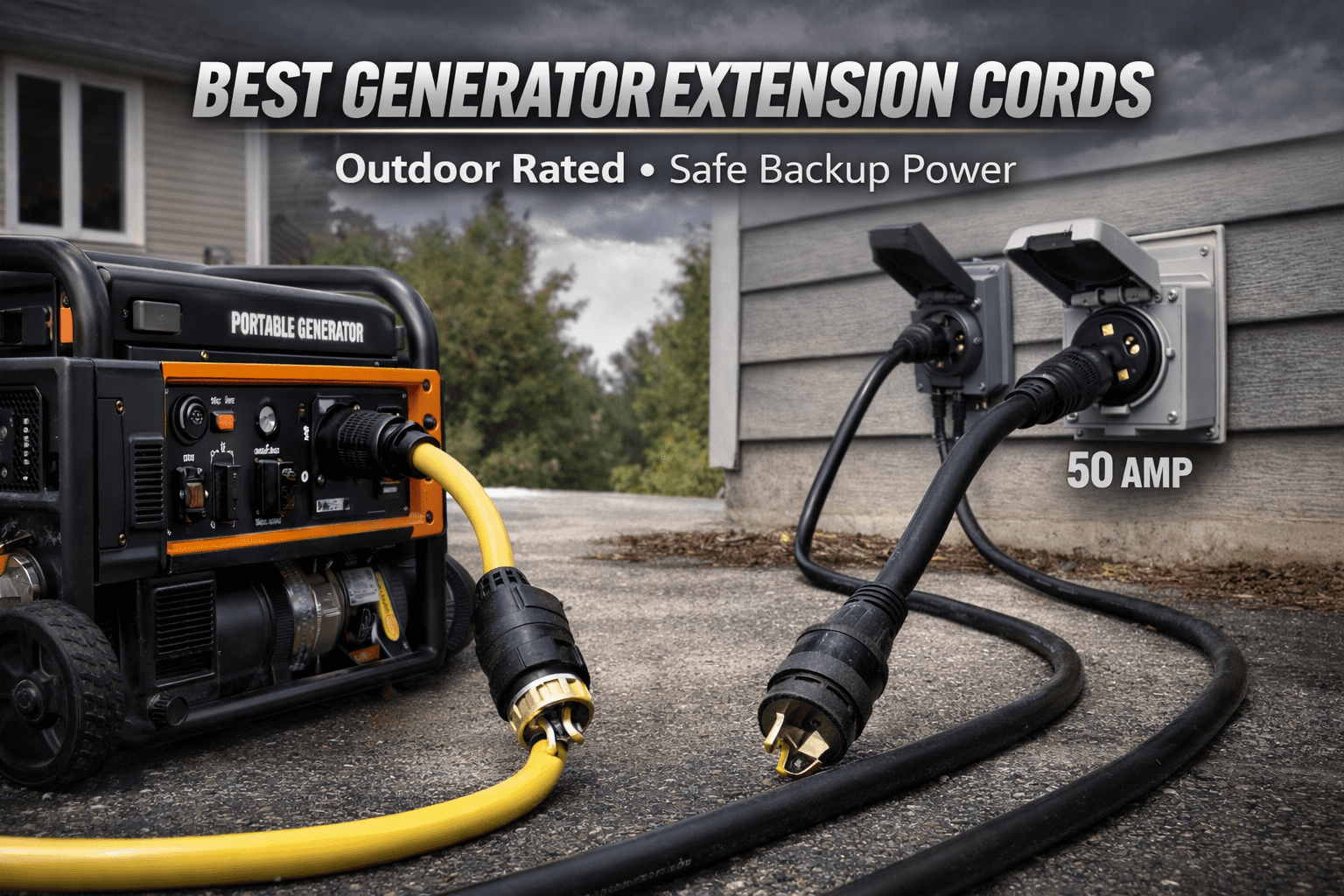
Tip: If your inlet box is SS2-50R (common), buy a 14-50P → SS2-50R cord. If your inlet is L14-50, buy L14-50. Match the inlet first.
Who this is for (and who it isn’t)
This guide is for you if you’re doing any of the following:
- Connecting a generator to a transfer switch / inlet box (most common “home backup” use)
- Powering an RV inlet or 50A setup
- Running power outside during an outage and want to avoid hot plugs, voltage drop, or tripped breakers
If you’re only plugging in a phone charger or a lamp: you don’t need a heavy generator cord. But if you’re powering anything with a motor (fridge, freezer, sump pump, furnace blower), buying the right gauge is what prevents melted ends and appliance damage.
________________________________________________________________________________________________________________
Best Overall (Most Homes): 30A L14-30 Cord (10/3, 50 ft, outdoor-rated)
Buy this if: your generator has a 30A L14-30 outlet and you’re running power to an inlet box / transfer switch (most common home-backup setup).
Why it converts (and why it’s safe):
- 10/3 copper is the correct “real-world” wire size for most 30A setups
- 50 ft gives reach without pushing voltage drop too far
- Twist-lock ends reduce arcing/heat from loose connections
- STW/SJTW jacket handles wet grass, rain, and abrasion
Before you click (30 seconds):
✅ Your outlet says L14-30 (4-prong twist-lock)
✅ Your inlet/transfer switch accepts L14-30
✅ Cord explicitly states 10/3 copper (not vague “10 gauge” marketing)
________________________________________________________________________________________________________________
Best 50A (Whole-Home / RV Inlet): 14-50P → SS2-50R (6/3 or 6/4, 25–30 ft)
Buy this if: your home/RV inlet is 50A and your setup uses an inlet box (many are SS2-50R twist-lock).
Why this is worth paying for: 50A loads create heat fast. The only real fix is more copper.
- 6/3 or 6/4 runs cooler than 8-gauge under load
- Twist-lock inlet ends reduce looseness, arcing, and hot blades
Do NOT buy until you confirm your inlet type:
- If your inlet says SS2-50R, you want 14-50P → SS2-50R
- If your inlet says L14-50, buy an L14-50 cord instead
Best Budget (Still Safe): 30A L14-30 (10/3, 25 ft)
Budget rule: you save money by going shorter, not thinner.
Buy this if: you only need 25 ft and you still want a cord that won’t run hot on real loads.
- Same correct copper (10/3)
- Less resistance than 50–100 ft runs
- Easier to store and deploy
Best Long-Run (75–100 ft): Heavy Copper Only (8/4 preferred)
This is where most failures happen. Long distance = resistance. Resistance = heat. Heat = melted ends.
Buy this if: you must place the generator far away (noise, fumes, HOA).
- For 75–100 ft on a 30A setup, 8/4 (or 8/3) is the move
- If you can shorten the run, do that first (shorter beats thicker)
Best Cold-Weather Flexible: SOOW/SJOOW Jacket (doesn’t turn stiff below freezing)
In cold weather, cheap jackets get stiff, pull on the plugs, loosen connections, and that creates heat.
Buy this if: you deploy cords in winter and want easier handling + safer connections.
Look for SOOW/SJOOW and molded strain relief.
________________________________________________________________________________________________________________
How we picked (so you don’t waste money)
We selected cords that meet the real failure points buyers run into during outages:
- Correct connector fit (L14-30 vs L14-50, twist-lock ends that don’t wiggle loose)
- Enough copper for the distance (wire gauge that avoids hot plugs/voltage drop)
- Outdoor-rated jackets (STW/SJTW/SJOOW) and molded strain relief at the plug head
- Clear rating + third-party listing (UL/ETL labeling where available)
If you match plug → length → gauge, you avoid 90% of the problems people blame on their generator.
Before you buy: 60-second checklist (prevents melted plugs)
- ✅ Plug matches your generator (L14-30 or L14-50)
- ✅ Gauge matches distance (10/3 for 25–50 ft @ 30A; 8/3+ for long runs)
- ✅ Jacket is outdoor-rated (STW/SJTW/SJOOW)
- ✅ You’ll run it fully uncoiled (coiled cords trap heat)
________________________________________________________________________________________________________________
FAQ
Q: Which is better, 30A or 50A?
A: Choose 30A L14-30 for most portable generators and partial-house setups. Select 50A L14-50 for whole-house or high-load transfers.
Q: When should I use 10/3 vs 12/3?
A: Use 12/3 only for short, light-load runs. Choose 10/3 for most 30A L14-30 applications and longer runs to reduce heat and voltage drop.
Q: How long is too long for a cord?
A: For cords over 50 ft, use a heavier gauge. For heavy loads and runs above 75 ft, select 6/3 or 8/3 depending on amperage to control voltage drop.
Q: Can I run a space heater on a generator cord?
A: Only if the cord and generator can handle the heater’s wattage. Space heaters draw significant current; use the correct gauge and avoid overloading.
Q: Do I need a transfer switch?
A: Yes. Always use a manual or automatic transfer switch or a proper inlet box. Never backfeed through a dryer outlet or breaker—this is dangerous and illegal in many areas.
________________________________________________________________________________________________________________
Conclusion
Match the connector, gauge, and jacket to your generator and cord length. The PlugSaf 50 ft 30A cord meets many home backup and RV needs with its weatherproof jacket and twist-lock ends. For longer runs or higher loads, use a heavier gauge. Always uncoil cords fully, keep connections dry, and use a transfer switch to prevent backfeeding. Select the cord that fits your outlet and load for safe, reliable power.
Before You Buy: 60-Second Checklist (Avoid Melted Plugs)
1) Match the connector first
- Most home setups: L14-30 (30A, 4-prong twist-lock)
- Whole-home/RV inlets: L14-50 (50A)
2) Choose wire gauge based on load + distance
- 30A: 10/3 is the standard
- Long runs: go heavier (30A long-run: 8/3 preferred)
- 50A: 6/3 or 8/3 (don’t cheap out)
3) Choose outdoor-rated jacket
Look for STW / SJTW / SJOOW (outdoor + weather resistant).
4) Use it safely
Fully uncoil the cord, keep connections dry/off the ground, and only power your home through a proper inlet + transfer switch (never backfeed).
Check price for the correct generator cord (match your outlet + gauge) on Amazon